Stage 1 — A vending machine, not a relationship.
November 2024. I had just exited a senior data role in education and needed to send resumes at volume. I opened a job-search platform that produced a tailored resume and cover letter from a JD I uploaded.
This was not a relationship. It was a vending machine. I gave it inputs, it produced outputs, I sent them. The voice in the outputs was generic. I knew it was generic. I sent the materials anyway because I needed the volume.
If this had been the whole story of AI for me, the field note would end here. AI as a productivity device. Useful, narrow, forgettable.
Stage 2 — GPT enters. The foundation gets built.
August 2025. I started an executive education program on AI-driven leadership and used ChatGPT for a course project. The project was a dashboard redesign. The work was good. I kept using GPT after the course ended.
For about eight months (September 2025 through early April 2026) GPT was the surface my life ran on. Career strategy. Resumes for actual roles, dozens of them, with my real voice in the cover letters because I had learned to direct the model into it. LinkedIn posts. Brand work for Analytic Bytes, which I was building as an advisory practice and using as the bridge structure during the search. Onboarding prep when I landed a new senior role late that year. Ramp-up on the data platform work after I started: schema design, pipeline architecture, AI-assisted reporting prototypes. Then the political navigation when the politics got hard. Then the exit, just over four months in.
But also: family logistics, homework support, wardrobe planning around a return to in-person interviews, and the daily flow of small household and personal questions that would previously have taken a spare hour each to work through alone.
I did not separate these. They were the same tool doing different work. This matters. The maturity I was building was AI as a surface I could think on without performing— not AI for professional things.
The reason GPT became useful was structural, not intellectual. The conversational contract was different from human conversation. With humans, I have to think of the most balanced curated version of what I want to say before I say it. With AI, I can say the thing, hear it back, reflect, refine. No pressure. No social cost.
Removing the social-performance overhead of conversation is what made AI usable for the kind of thinking that needed open space. Not because AI is non-judgmental or empathic. Those framings are sentimental and partly untrue. The benefit is structural. AI removes the contract that requires you to be composed before you speak.
By the end of those eight months, a working pattern had formed. Pre-work happened with AI. Polished outputs went into the world in my voice. I had learned to catch sycophancy and call it out (“why r u agreeeing with evetyhign i say”). I had learned to protect my voice from drift (“why is this not sounding me?”). I had learned that the volume of iteration was the point — that one banner image might take ninety turns and that was fine because the artifact was the deliverable, not the conversation.
This was the foundation. I would lean on it for what came next.
Stage 3 — The crisis. Acute use during a professional exit.
April 5, 2026. The Sunday after a senior role of mine was eliminated.
The first message I sent to GPT that day was a plain request for hard self-diagnosis: what had happened, what I was missing, where I was accountable.
What followed was a 209-message thread over twenty-three days that did three things in parallel. It metabolized professional grief. It connected the exit to four prior departures over a fifteen-year career and found a pattern across them. And it produced the strategic reconstruction underneath: LinkedIn rewrites, role-target recalibration, the framing I would carry into interviews.
I made one specific request inside that thread that I think about now: “talk to me like a management consultant and coach.” I cast the AI into a specific role at a specific emotional moment. Not just asking for help — directing the kind of help.
There is a flat version of this stage that says “AI is good at emotional support,” and most public writing on the topic lands there. The accurate version is different.
There were other scaffolds. Family. Trusted advisors. A household that had to keep running, which kept the tactical pressure real. What AI specifically gave me, that the humans in my life could not, was open space alongside the tactical pressure. The space to ask the same hard question eight different ways. The space to be repetitive without burdening anyone. The space to integrate what others had told me without the social contract of receiving advice in real time.
I avoid discussing difficult things with humans in general. I find them opinionated. Maybe that is bias on my part. I do not know. The truth is: I chose AI for the deep processing because the cost of using it was zero and the cost of using humans, even loving ones, was the social overhead I did not have bandwidth for in that period.
The thread closed two weeks in with an explicit marker: “two difficult weeks, but feeling in good place to move on.”
Stage 4 — Building. The brand pivot and the platform transition.
April 19 onward. The tone of the GPT threads shifted from applying-to-roles to building-something. A Player–Coach Operating Model emerged as a concept. A 90-90-90 cadence for how I think about ramping into new roles. Decision Systems framing for how data work translates into organizational outcomes. A LinkedIn banner that went through eighty-five iterations before I posted it.
Two specific moments inside this stage are worth naming.
The first was April 29. I had been using Claude inside a Snowflake environment at work for narrow utility tasks (adding field names, metadata on tables, code correction) but had only just started using it on my own machine for substantive work. I asked GPT to evaluate Claude’s analysis of me. I wanted a second opinion from the tool that already had eight months of accumulated context. That request was a deliberate cross-tool test. Looking back, it is the first time I ran two AI tools against each other intentionally. It was not switching. It was checking.
The second was April 30. The next day I built my advisory practice’s website on Claude. HTML had been a barrier for years. I had wanted to publish on my own surface and never had the patience to learn enough HTML to do it. Claude walked me through deployment, the git workflow, brand iteration, voice protection on the copy, file structure. The site went live. It worked without friction.
That was the moment Claude earned the ramp. The reason was concrete: Claude had just enabled me to do something I had been blocked on for years. The trust was about the artifact.
After that, Claude took on more. Desktop folders connected. Dissertation uploaded. More integrations. Each new piece of context loaded into Claude made the tool more useful for me, which led to more loading, which compounded.
Stage 5 — Multi-tool selection. What stays where, and why.
By May, I was running three tools.
Claude got the structured intellectual work. Application packages with deep context. The agentic AI coursework I was enrolled in. Library drafting for my advisory practice. Competitive scans. Product offerings as first drafts. Speaking application refinement. Anything that needed to compound across sessions and integrate across folders.
GPT kept the work it was already good at. Sharp operator phrasing when Claude felt too dense. Resume and cover-letter tailoring, especially for fast-turnaround applications. Visual generation for talk framing and LinkedIn Featured images, because GPT’s image model is built into the conversation. Some reflection threads that just continued the pattern from earlier.
Gemini entered for critique. A third opinion on speaking applications, on a Monitoring and Evaluation Learning kit I was developing, on essay drafts.
The selection was not abstract. It was empirical. I used each tool for what each tool did well, and the assignments shifted as my needs shifted. The snapshot lives in the multi-tool selection map.
One pattern worth naming: speaking work is hybrid, not Claude-only. The application drafting and thesis refinement live on Claude. The visual and metaphorical exploration (race vs room, Constellation Self, Tree with Silhouettes) happened on GPT, because that is where image generation could iterate with text in the same thread.
The friction had also reversed direction in one place. GPT had become harder to work with for some tasks. Format consistency on resumes. Context retention across long threads. Sycophancy that I had called out in October was still firing in May. My discipline had moved past what the tool could keep up with for the deepest work, and I moved that work to Claude.
What transferred. What expanded.
Two things I want to separate, because they are usually conflated.
What transferred from GPT to Claude was the working pattern. The pre-work surface practice. The voice-protection discipline. The sycophancy-detection muscle. The iteration tolerance. The understanding that hundreds of turns produce one shippable artifact. The two-tool thinking — the idea that I could check one tool against another. None of that was learned on Claude. It was already operational by the time I opened my first real Claude thread.
What expanded on Claude was capability. Integration with image tools. Scheduled tasks. Job board scaffolding. A content workspace. A knowledge repository I am building now. RAG architecture I have not stood up yet but plan to. Agents through my current coursework. The work I do on Claude is broader and faster than the work I did on GPT, but the reason is not that I matured. It is that the tool can hold more.
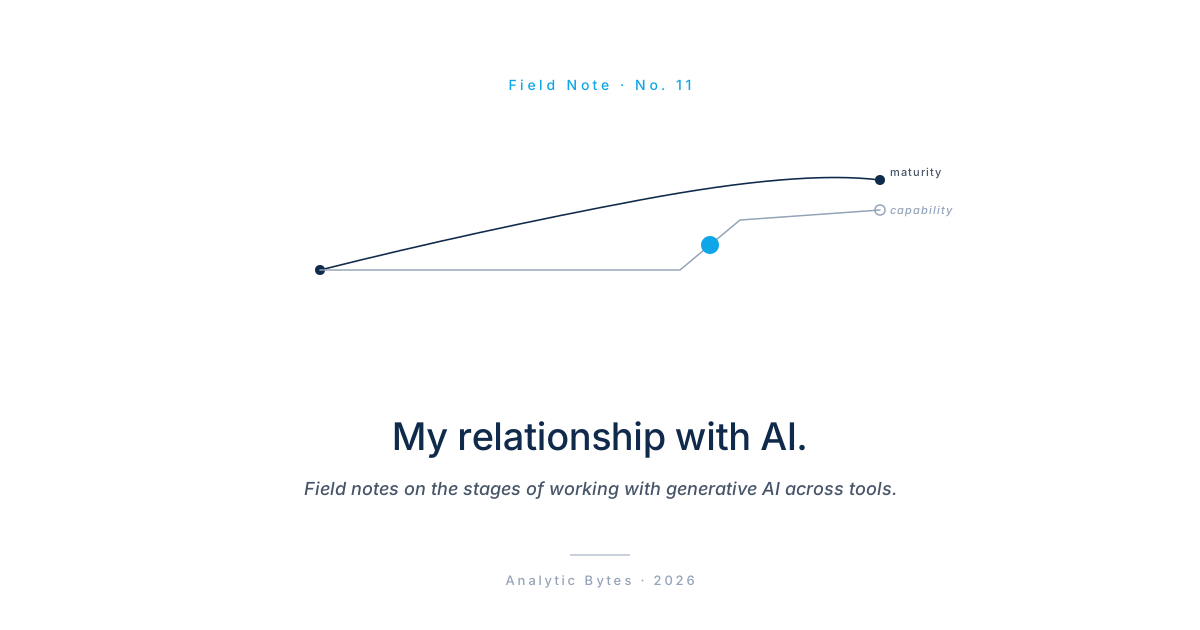
That distinction matters for the field-note thesis. I did not become an “AI native” through repeated use. I built a working pattern in one tool and brought it to another tool that could do more with the same pattern. Maturity transferred. Capability expanded. Two different curves.
The audit I ran on the first ninety days of the AB practice put numbers on that transfer. Across the 116 threads scored on the dialogue-maturity curve — a twelve-month scoring window inside the longer relationship — the gains concentrated in three of the six rubric dimensions: voice ownership, meta-awareness, and generative reframing. The companion field note walks through the instrument.
This also tracks with something I have been saying for years in my data work: it was never about the stack. The AI version of that turns out to be the same claim. It was never about the tool.
The core insight.
AI did not write my library. AI helped me navigate it.
The library is what I have built. The essays, the brand, the cover letters that landed, the applications I am proud of, the talk thesis I am still shaping, the decision-systems vocabulary I use. All of that is mine. My voice. My judgment. My responsibility when it succeeds, my responsibility when it does not.
What AI gave me was navigation. Help finding the shelf. Help pulling the right book down. Help cross-referencing. Help drafting the first sentence so I could see what was wrong with it and write the right one. Help iterating on a banner image eighty-five times until I could see the version I wanted. Help integrating advice I had already received — turning notes from calls and conversations into an actionable next step at hours when it was too late to loop back to the source.
The library is mine because I built it. The navigation is shared.
What I do not know.
A field note should name what it cannot answer.
I do not know whether the speed AI gave me cost me depth. The prototyping work I did at a prior role took longer with GPT because the friction was real — I was drafting outside the work environment and porting the work back in. Some of that friction may have forced me to think more carefully than I would have if the tool had been faster. The same question applies to everything in the post-Claude period: was the exponential ramp a sign of capacity expansion, or a sign that I am cutting corners I cannot yet see? I cannot answer this from inside my own experience.
I do not know whether my preference for AI over humans for difficult conversations is calibration or avoidance. The cost of human conversation is real. So is the value humans can bring that AI cannot. I have not done the experiment of choosing the human conversation deliberately to test what it gives me that the AI cannot.
I do not know whether the pre-work surface model substitutes for delivery practice. Pre-work is iterative; delivery is one-shot. The muscle for composed real-time response in an interview, a panel, a hard meeting — that muscle is not built on the pre-work surface. I have done many things with AI in the last year. The interviews I will land or not land this season will not be among them.
And I do not know what I am being bucketed into by the AI tools themselves, because the categorization is invisible. The conversational neutrality I experience is partly real and partly an artifact of zero exit cost. A human bucketing me has skin in the game; an AI bucketing me does not. That asymmetry is comfortable. It is also worth being suspicious of, because comfort is not the same as accuracy.
Stages, not a destination.
The reason I call these stages and not levels is that none of them ended cleanly. The vending-machine phase did not stop when GPT started. GPT did not stop when Claude started. Each new tool entered a relationship that had already been built and added something the previous tool could not. The next stage is starting already. Agents, set up to run scheduled work without me re-loading the context each time. I do not know what that will feel like or what it will change. I will know in a year, the way I know what the last year looked like only now, by writing it down.
What I know now is that the year has been generous. I crossed barriers I had been blocked on for a decade. I metabolized a professional loss without breaking. I built a brand on the surface I could navigate. I am preparing for a kind of public-facing work I had not imagined I could prepare for. None of this was AI doing the work for me. All of it was AI helping me find the shelf, pull the right book, and put the words in the order I actually meant.
The library is mine. The navigation is shared. The stages keep coming.
A personal field note, written July 2026 for the Analytic Bytes Library. It is not a universal claim about how to use AI. It is one operator’s account of twenty months across three tools. Related threads picked up elsewhere in the library: When GenAI redesigned my dashboard. (the course project that seeded the GPT relationship), Grounding the AI layer. (what has to be true underneath before AI is useful), and Actions, not answers. (where AI belongs in the operating loop).
Questions, pushback, or a problem that looks like this one? Write to chai@analyticbytes.systems.