Let’s start with what an “agent” is, because the demo obscures it. An agent is the same kind of model as any other, with two things added: tools it can call, and a change in how its output is read. The same text a chatbot would hand back as a reply, an agent treats as a program — an instruction to go do something. Read as a reply, the output is an answer. Read as a program, it is an action. That interpretive shift, plus the tools, is the whole of it.
It sounds small. It is not. It is the difference between a tool you use and a system you manage, and most of what a leader needs to weigh follows from that one line.
A working definition, the kind you would say at the start of a meeting (I drafted this for my MIT capstone playbook and use it now in client conversations): agentic AI is a software system that takes a goal, plans its own next moves across your tools and data, and produces actions rather than answers. Hold onto “actions rather than answers.” Everything else is downstream of it.
Throughout the rest of this piece, I’ll keep coming back to one workflow as the worked example: AB’s “Deliver Signal,” the first ninety days of how I take a mission-driven client from fragmented sources to one decision-ready surface an executive and a frontline operator can both act on. It is the candidate workflow I worked through in detail for my MIT capstone, and it is also the work I am doing, currently end-to-end myself, with AI augmentation in code, prose, and analysis. It surfaces every decision this essay will walk through: where the human checkpoint sits, where the agent’s autonomy ends, what safeguards have to hold, and who owns the result.
The checkpoint that used to be free
When an AI system produces an answer, a decision still has to happen. Someone reads the answer, judges it, and acts on it, or doesn’t. That human decision point is not something anyone designed in. The format holds the seat for a checkpoint, whether or not the person uses it. An answer is inert until a person picks it up, and the picking-up is where the checkpoint can happen — even if the person only skims.
When an AI system produces actions, that checkpoint is gone by default. The agent books the appointment, sends the message, moves the money. The decision still gets made; each of those is a decision. But now the system makes it, at its own speed, unless a human was deliberately designed into the path.
The move underneath is a relocation. Agentic AI does not add a decision to your organization; it relocates one. It takes a decision that used to belong, by default, to a human who got it for free, and hands it, by default, to a model. Every “let the agent handle that” is a decision about who holds decision authority, made whether or not anyone in the room noticed they were making it.
That is why this is a decision-system redesign and not a tooling upgrade. A tooling upgrade changes how a step gets performed. This changes who performs the deciding.
Most data problems are still decision problems
There is a claim at the center of how Analytic Bytes reads every one of these situations: most organizations do not have a data problem. They have a decision-system problem. The decisions are unnamed, unowned, made by default, or resting on signals nobody checks.
Agentic AI does not change that claim. It sharpens it to a point. An organization that never named which decisions its workflows make, who carries them, and what evidence they stand on has a decision-system problem whether or not AI is anywhere near it. Hand that organization a set of agents and it does not get those questions answered. It gets them executed: unanswered, at machine speed, by a system that will not pause to ask. The confusion was survivable when a human sat in every loop, slow enough to catch it. Take the human out of the loop and the confusion is what runs.
The unexamined decision system does not get fixed. It gets automated.
So the readiness question for agentic AI is not “is the technology good enough.” The technology is good enough to force the governance question, though not good enough for every action. The question is whether the decision system underneath is clear enough to be worth speeding up.
Putting the checkpoint back, on purpose
If the free checkpoint is gone, the work is to build a deliberate one. Two disciplines do most of that work.
The first is a threshold map. For any workflow you are considering handing to an agent, draw the line three ways. Where may the agent act entirely on its own? Where must it stop and pass the decision up to a human? And where must the human start the decision in the first place, with the agent not acting at all, only assisting? Most teams never draw this map. They let the vendor’s default draw it, which means the line ends up wherever the demo happened to put it.
For AB’s Deliver Signal workflow, the three zones look concrete. Take source-inventory tagging, where the agent categorizes each new client data source by ownership, freshness, and criticality. The agent acts on its own when ownership is clear, freshness signals agree, and the source fits a known pattern from AB’s procedural memory. It escalates when ownership is ambiguous, freshness signals conflict, or the source is a new-to-AB system type. And I originate the decision before the agent touches any metadata when the source carries regulated data: student PII, EHR records, claims data. The same workflow has different lines for different decisions inside it. Drawing the map once is not the discipline. Drawing it per decision is.
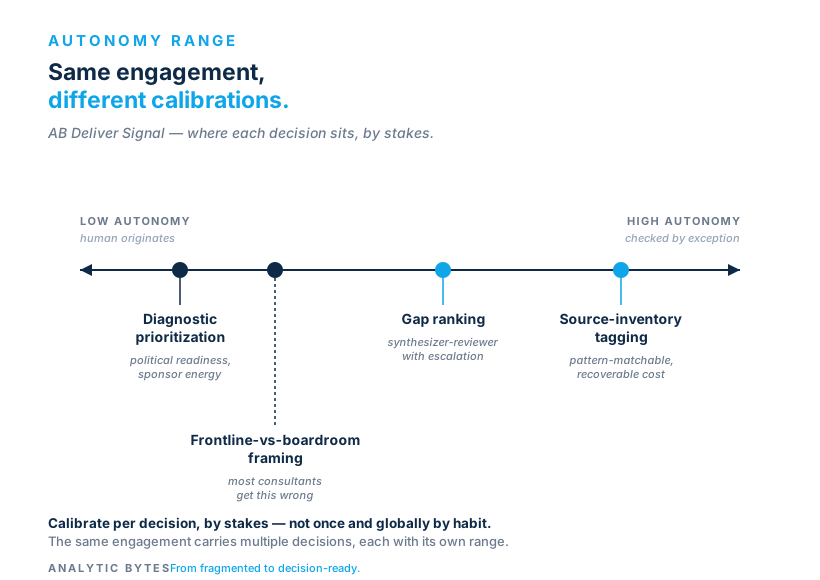
The second move is recognizing that autonomy isn’t a binary setting. An agent isn’t “autonomous” or “not.” For each task, in each context, it sits somewhere on a range: from only returning pre-verified responses, to acting within tight rules, to acting with every consequential move reviewed first, to acting freely and checked only by exception. The discipline is to calibrate that range per decision, by stakes, not once and globally by habit. A low-stakes, highly repeatable decision can sit well along the range. A decision that is rare, hard to reverse, or lands on a vulnerable person should not, however capable the model looks in a demo.
In AB’s case, that calibration looks different across the same engagement. Source-inventory tagging sits well along the range, because the criteria are pattern-matchable and the cost of an individual wrong tag is low and recoverable. Diagnostic prioritization, choosing which of the client’s many problems is the highest-leverage gap to close first, sits much closer to the human-only end. The criteria there (political readiness, sponsor energy, data quality, frontline pain) trade off against each other in ways the agent can’t yet weigh, and the cost of getting it wrong is months of misdirected engagement.
Readers of earlier pieces will recognize the shape: it is the same risk-and-repeatability logic that decides where AI authority sits in any deployment. Agentic AI does not introduce that question. It raises the stakes on getting the answer written down.
You cannot bolt safety onto the model
Two design truths close the loop, and both cut against instinct.
The first: do not rely on the model to keep itself safe. The temptation is to make the model careful, with better instructions and sterner prompts. But a system whose safety depends on the model choosing well, every single time, has no safety at all. Safety has to be built into the structure around the model. Start with reversibility: an action designed to be undone has margin for the other layers to fail. Then hard limits the agent cannot cross because they are enforced in code, not requested in a prompt. Then an independent second check that does not share the first model’s blind spots. Then a human escalation path more than one person deep. Layered defense, because any single layer will eventually fail, and the design has to assume it.
For AB’s Deliver Signal workflow, that stack looks specific. The agent’s outputs (source tags, gap rankings, draft dashboards) are all reversible because the artifact lives in AB’s working environment, not in client production systems, until I sign off. The hard limits live in code: the agent cannot touch regulated-data systems without my explicit pre-approval, and it cannot ship a deliverable to a client. The independent check is a separate model reviewing the synthesizer’s gap rankings before they make it into a draft. The human escalation path is short by design (there is only me), but the design assumes that short path is the wrong long-term answer.
The second design truth is the comparison the conversation most often gets wrong. The question to ask of an agent is not “does it make mistakes?” Of course it does. So does the human process it would replace. The honest question is whether this agent, with its safeguards, produces better decisions than the process it replaces, on the dimensions that matter. That reframe keeps the conversation off a fantasy (agent versus perfection) and on the real choice: the agent and its safeguards together, weighed against a status quo that had its own error rate all along, usually unmeasured.
This is also where AB’s ed-tech and behavioral-health client conversations diverge before the comparison can even be made. In ed-tech, “agent” tends to mean an LLM-wrapped assistant that helps a teacher draft a lesson, and the comparison is straightforward, against the lesson the teacher would have written. In behavioral-health, “agent” gets confused with regulated staff roles (intake agent, case management agent) or with RPA bots already approved under HIPAA review. The comparison cannot be made until that definitional confusion is cleared with the Chief Clinical Officer or whoever holds the regulated-data accountability.
Evaluation does not end at launch. Because the model drifts, an agent has to be watched continuously: its override rate, its disagreement signals, its slow slide as the ground shifts. The monitoring surface is no longer a quarterly report but a conversation you are now having with a system still out there making decisions in your name.
The job becomes management, not use
This is the consequence leaders most often miss. When AI produced answers, the human’s relationship to it was use, the way you use a calculator or a search box. When AI produces actions, that relationship has to become management. Every agent has to have a named owner: a specific person accountable for what it does.
Managing an agent is a new job, with new responsibilities that no prior role quite contained. The owner calibrates the thresholds as the agent’s behavior drifts, and it will drift, because the model underneath gets upgraded by a vendor on a schedule nobody consulted you about. The owner decides which patterns the agent carries forward and which it lets go. And the owner does the hardest thing of all: refusal. Deciding, in real time, that a particular case is one the agent should not touch, and being able to defend that call.
For AB’s first agentic workflow, I’m the day-to-day owner. That’s uncomfortable but honest: at AB’s current scale there is no other person, and the agent’s job is to do work I would otherwise do myself. The role becomes a formal hire only once the operating standard is documented well enough that an AB associate could supervise the agent against it, and once at least one engagement has run through the agent cleanly enough to know what “right” looks like. The first agent-owner hire is then a deliberate role, not a generic engineer.
An organization that deploys agents without naming who owns each one has installed a decision-maker without an accountable seat. When the agent makes a bad call, the question of who carries it has no answer prepared, and the cycle that follows tends to be slower than the call that caused it.
What this asks of a leader
The leader’s real question was never “should we adopt agentic AI.” It is narrower and harder, and it is a list: for which decisions, at what point on the autonomy range, with what checkpoint, owned by whom, watched how. Not one of those is a technology question. Every one is a decision-system question, and they were the right questions to ask long before agents existed. Agentic AI’s real effect is that it removed the option of leaving them unasked.
For AB, working through that list is the work, not a preliminary to the work. The Deliver Signal workflow gets handed to an agent only after the decisions inside it have been named, the owners assigned, the thresholds drawn, the safeguards built. An organization that does this first can gain real speed without losing the thread. An organization that hands an agent its confusion gets the confusion back faster, with no human in the loop slow enough to notice.
The discipline is not in any single safeguard. It is in the architecture, the cadence, and the refusal to relax the bound at the moment relaxing it would be convenient. From fragmented to decision-ready was always the work. Agentic AI did not change that. It only raised the price of skipping it.
Written May 2026 for the Analytic Bytes Library. The argument adapts several frameworks from MIT Sloan’s Agentic AI Development program: the autonomy spectrum, the four safeguard layers, the human-in-the-loop threshold pattern, the comparison-that-matters reframe, and the “every agent needs a manager” positioning. The working definition and the AB Deliver Signal worked example come from the author’s program capstone playbook. The original contribution here is the “free checkpoint” framing and the decision-system reading of agentic adoption. A future field note will revisit this argument once AB’s first agentic workflow has been deployed and run.
Questions, pushback, or a problem that looks like this one? Write to chai@analyticbytes.systems.