1. Fairness across subgroups — two tests, not one.
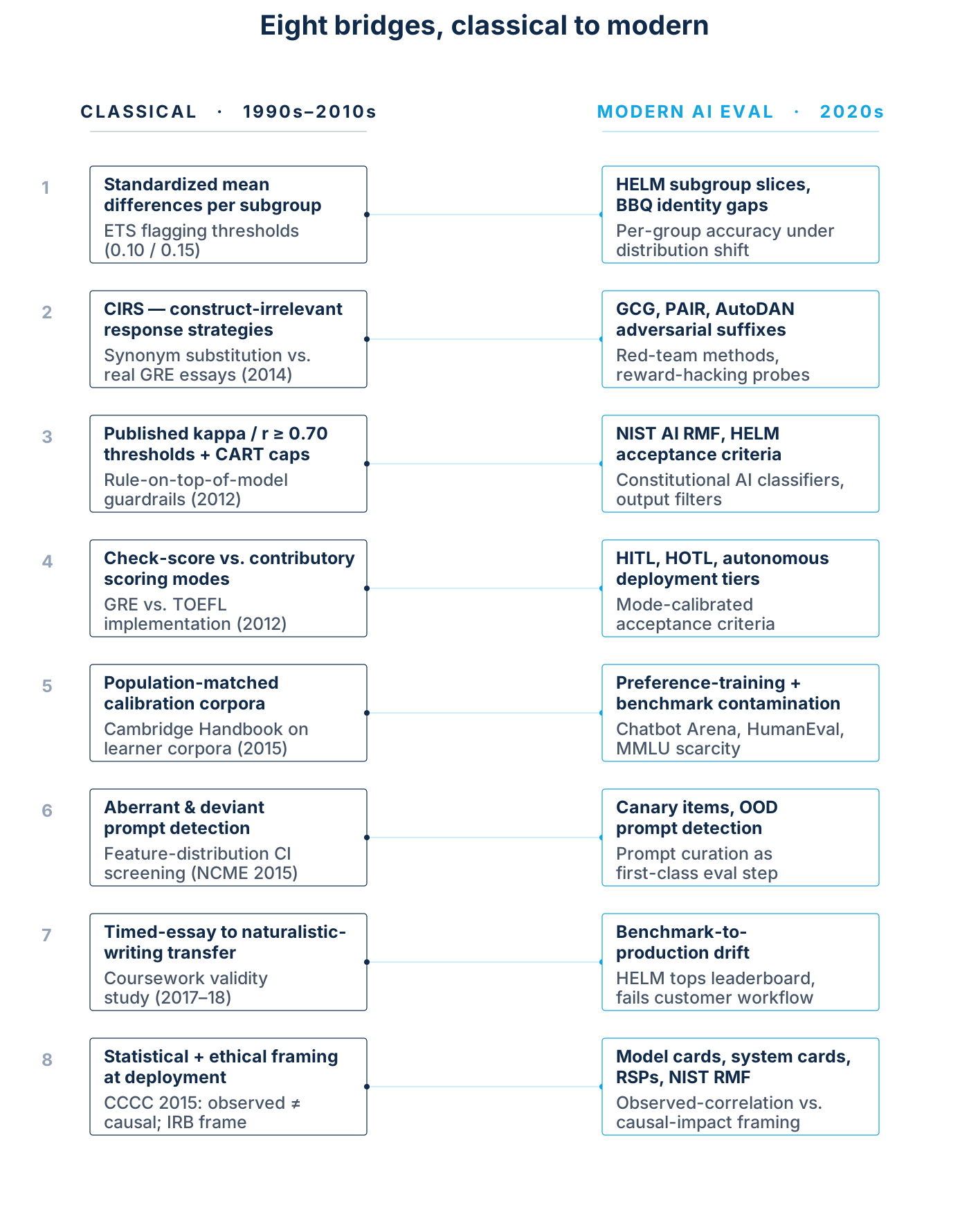
The modern version: HELM (Holistic Evaluation of Language Models) slices its benchmarks by demographic subgroup, BBQ (Bias Benchmark for QA) measures accuracy gaps across identity axes, and enterprise LLM audits routinely check whether a model’s error rate differs materially for one population versus another. The methodological punch is that a single aggregate metric — accuracy, F1, human-rater agreement — can hide a substantial subgroup gap. Only per-group evaluation surfaces it.
The classical version, in automated essay scoring, was doing this two ways at once. The first test was the surface fairness check: standardized mean score differences between the machine and human raters, computed per subgroup, with an ETS-published flagging threshold of 0.10 for any subgroup of concern — deliberately more stringent than the 0.15 flagging threshold for the overall gap (Ramineni & Williamson, 2012). The second test was a validity-of-the-scoring-claim check: differential predictive validity. Compare the correlation between the human score and an external criterion, within a subgroup, against the correlation between the machine score and the same external criterion, within the same subgroup. If those two correlations diverge, the human and the machine are not measuring the same thing for that population, even if their aggregate scores agree. Modern AI eval has begun folding the equivalent into “fairness under distribution shift” — measuring downstream-task performance per demographic slice, not just benchmark performance.
The receipt for the mechanistic version of this discipline is the 2018 ETS Research Report on demographic subgroup differences in GRE Analytical Writing (Ramineni & Williamson, 2018). N=215,000 operational responses across 215 prompts. Three subgroups flagged on the Argument task: standardized mean e-rater–human differences of +0.56 for examinees from China, −0.19 for Taiwan, and −0.11 for African American test-takers. Four alternative regression architectures compared head-to-head. Expert re-scoring of the maximally discrepant essays. Two independent mechanistic hypotheses tested with dedicated tooling. What that paper showed is that the discrepancies were architectural in origin rather than a form of adversarial bias. Human raters were using conditional, rule-based logic — gating on language control errors before assigning organization scores. e-rater was using linear weighting of all features, which allowed strong organization scores (correlated with essay length) to offset weak language control. The subgroups where the two scoring architectures diverged the most were the subgroups whose writing patterns triggered that offset the hardest. Modern AI eval calls this rationale-alignment failure. The discipline for finding it is not new.
2. Adversarial evaluation — CIRS before GCG.
Modern AI eval has developed a class of methods for testing whether an LLM’s outputs can be manipulated by adversarial inputs. Gradient-based attacks like GCG (Greedy Coordinate Gradient) produce prompt suffixes that jailbreak alignment. PAIR (Prompt Automatic Iterative Refinement) uses one LLM to attack another. AutoDAN generates readable adversarial prompts. The unifying diagnostic method is three steps: posit a strategy that gains reward without gaining ground on the target construct, implement it programmatically, measure the reward delta on real inputs.
That method was named and operationalized in the automated-scoring literature in 2014 as Construct-Irrelevant Response Strategies — CIRS (Bejar, Flor, Futagi, & Ramineni, 2014). The paper built a lemma-indexed synonym-substitution algorithm that swapped a portion of words in real GRE essays for longer, less-frequent synonyms. Ten to thirty-five substitutions per essay. Then it rescored the manipulated essays with e-rater and measured what happened. What happened was that the vulnerability was real, and asymmetric: substituting five percent of words with longer, rarer synonyms produced meaningful score gains for lower-scoring essays but had negligible or opposite effect on high-scoring essays. The exploit was strongest where the stakes for the examinee were highest.
The CIRS paper was explicit that the vulnerability followed directly from e-rater’s inclusion of word-frequency and average-word-length features. Any AES (automated essay scoring) system that weighted lexical sophistication was exposed to the same class of attack. And CIRS was proposed as a general evaluation category, not a one-off finding. The synonym-substitution was an illustration of a broader method: simulate a plausible strategy against real responses, then measure the score delta. That is the diagnostic template modern LLM red-teaming inherits.
3. A priori published thresholds — and guardrails on top of learned models.
Modern AI evaluation is still consolidating its methodology for what “an eval passes” means. NIST’s AI Risk Management Framework proposes categories. HELM publishes multi-metric scenarios with per-scenario acceptance criteria. The Language Model Evaluation Harness standardizes scoring conventions. What these have in common is the discipline of publishing performance thresholds a priori — before deployment — with named justifications, so that adoption is not judged post-hoc against whatever number came out.
That discipline was formalized for automated essay scoring in Ramineni & Williamson (2012). The paper’s Table 1 gives the quantitative gates directly: quadratic weighted kappa of at least 0.70 between machine and human, Pearson r of at least 0.70, degradation from human-human to human-machine of no more than 0.10, standardized mean score difference of no more than 0.15 overall and no more than 0.10 per subgroup of concern. The subgroup threshold is 33 percent tighter than the aggregate threshold on purpose. The 0.70 threshold is not arbitrary; the paper names its justification as “the tipping point at which signal outweighs noise in the prediction and so at least half the variance is accounted for.”
The 2012 NCME (National Council on Measurement in Education) paper that used Classification and Regression Trees (CART) to trace the mechanistic gap between human and machine raters (Ramineni, Li, & Breyer, 2012) added a discipline that modern AI eval is beginning to develop under a different name. CART showed that humans conditioned on language control as the first splitting variable; e-rater weighted organization and development as the most important feature. The proposed remedy was to add a rule on top of the model rather than retrain it — “implementing a cap on the organization and development scores for responses that fail to meet a certain threshold for content scores” — so that essay length could not offset weak content. That is a guardrail-rule stacked on a learned model. It is the same architectural pattern Constitutional AI classifiers and output-filtering safety layers use on top of LLMs today.
4. Risk-tiered deployment — check score vs. contributory.
Modern AI evaluation increasingly frames deployment as a tiered decision. A model can be evaluated as capable enough for a chat assistant but not for autonomous agentic tool use. A safety eval that clears one deployment mode does not clear another. The framework distinguishes human-in-the-loop, human-on-the-loop, and autonomous operation, and calibrates its acceptance criteria to the mode.
That distinction has been operational in automated essay scoring since the 2012 GRE and TOEFL evaluation reports (Ramineni, Trapani, Williamson, Davey, & Bridgeman, 2012a and 2012b). The two papers evaluated the same scoring engine, e-rater, against two different implementation modes. The GRE program adopted what the papers named “check score” or “confirmatory” mode: the e-rater score is used only to check or confirm the human rating, and when within the allowable discrepancy threshold, the human rating constitutes the final score. e-rater does not contribute directly to the reported score. The operational impact of that posture was substantial — 41 percent of Issue responses and 47 percent of Argument responses triggered a second human rating. The TOEFL program adopted “contributory” mode: the mean of the e-rater score and the human rating yields the final score. That posture triggered a second human on 3 percent of independent responses and 33 percent of integrated responses.
The 2012 guidelines paper (Ramineni & Williamson, 2012) is explicit about why the modes differ: “For implementation of AES in contexts that are less consequential, such as practice tests and other settings, the criteria may be relaxed somewhat. By contrast, use of AES as the sole score, with no human counterpart, for consequential assessment, the criteria may need to become more rigorous.” The GRE paper is more specific about the risk logic: “As a more conservative approach, check score or a confirmatory score model was identified as a potential alternative implementation of automated scoring.” That is deployment mode chosen as a safety response to observed subgroup discrepancies, not as cost optimization. Modern AI eval is arriving at the same principle by a different route.
5. Population-matched training and evaluation corpora.
The modern AI eval discussion of training data has, in the last few years, converged on a set of concerns: preference-training datasets should reflect the target population, red-team corpora should include real distribution attackers, and benchmark corpora should not be contaminated with pre-training data. Shared datasets are recognized as an open problem — Chatbot Arena, HumanEval, HELM scenarios, MMLU (Massive Multitask Language Understanding) each carry their own limitations, and the field is publicly navigating the shared-eval scarcity.
That discipline is not new to automated scoring. The Cambridge Handbook of Learner Corpus Research chapter on automated scoring (Higgins, Ramineni, & Zechner, 2015) laid it out explicitly across writing and speech scoring. Calibration corpora ranged from 400 to 1,200 responses per prompt, with a train/validation split, evaluated using quadratic weighted kappa, Pearson correlations, and standardized mean score differences. Population-matched training was non-negotiable: “Trying to apply scoring models from GRE to TOEFL and vice versa can be problematic because of the differences in the population for the two tests.” That is the classical statement of the distribution-shift constraint. Speech-scoring corpora carried an additional problem the chapter named directly: word error rates on non-native speech reached about 50 percent versus 13 to 17 percent for broadcast news, so the training corpora required manual transcription and were often locked inside the commercial organizations that produced them. “The use of learner corpora in this field is currently rather fragmented, with the result that findings are difficult to compare and generalize.”
Modern AI eval is having exactly this conversation about shared datasets, benchmark contamination, and closed evaluation regimes at commercial labs. The chapter’s insistence on population-matched training, held-out validation, construct-appropriate feature design, and shared datasets for cross-lab comparison is a point-for-point ancestor of that discussion.
6. Prompt and eval-item curation — screening what you evaluate.
The modern eval field has begun to notice that a benchmark is only as informative as the prompts inside it. Benchmark contamination, prompt saturation, and out-of-distribution prompts are all recognized failure modes. Canary items are used to detect training-data leakage. Prompt engineering has become a discipline of its own. Some evaluation frameworks now include prompt curation as a first-class step.
Two NCME 2015 conference papers formalized a version of this discipline for automated scoring. The first (Williams & Ramineni, 2015) developed an aberrant-prompt detection method: compute feature-distribution confidence intervals across the existing prompt pool, then count feature violations on new prompts to flag those whose response distributions fall outside acceptable ranges. That is out-of-distribution detection for eval items, before the term existed in the LLM context. The second (Ramineni, Mattar, Tessema, Li, & Schultz, 2015) worked on deviant prompts: generic scoring models could pass at aggregate but fail on individual prompts, and those failures were then routed to content experts to inform future prompt authoring. That is eval-driven benchmark curation as a feedback loop. Both papers were framed as replacements for expensive item tryouts — automated screening as an operational efficiency, not only a research method.
These are conference-paper receipts, less formal than the journal work, but they name a discipline modern AI eval is now building without the prior vocabulary. The screening question — is this prompt one your scoring system can be trusted to score — is the same in both worlds. The tools differ. The problem does not.
7. Cross-domain generalization — validity in naturalistic settings.
The sharpest current question in AI evaluation is whether a model’s benchmark performance carries over to real-world use. LLM leaderboards do not resolve this. A model that tops HELM can fail on a domain-specific customer workflow. Generalization from curated benchmarks to naturalistic user data is where deployed AI systems live or die, and modern eval methodology is still developing the tools for measuring it.
The classical automated-scoring literature confronted the same problem directly, and the receipt for that work sits in the 2017 paper I co-authored with Brent Bridgeman, published in Assessing Writing (Bridgeman & Ramineni, 2017). The paper carries the essay’s opening thesis — that agreement with human scores on the same essays is a reliability indicator, not a validity strategy — and proposes naturalistic writing samples (writing produced under real conditions, not standardized-test conditions) as a stronger validity criterion. It executes the method by training new automated scoring models on first-year graduate coursework writing samples across disciplines, evaluated with a holistic rubric by trained human raters, and testing whether features from an existing timed-essay scoring engine transfer. The result was informative in both directions. The features applied. But their weights in the coursework model diverged substantially from their weights in the timed-essay model.
That divergence is the classical version of the modern generalization question. A scoring model trained on one construct-representation (timed impromptu writing) does not automatically hold on another (untimed authentic coursework), even when the underlying construct (writing quality) is nominally the same. The features carry across; the weightings do not. Modern AI eval is discovering the same pattern with LLM benchmark-to-production drift. The evidence for it in the automated-scoring literature has been on the record for eight years.
8. Responsible-AI framing at the point of deployment.
The modern responsible-AI discussion has developed a set of framing conventions: model cards, system cards, responsible scaling policies, IRB (Institutional Review Board)–equivalent review processes, ethical guidelines for training-data provenance, and a growing distinction between observed-correlation claims and causal-impact claims in reporting on AI systems. NIST’s AI Risk Management Framework organizes many of these. Anthropic’s Responsible Scaling Policy, OpenAI’s system cards, and comparable industry frameworks operationalize them.
In March of 2015, I gave a talk at the Conference on College Composition and Communication in Tampa titled “Risks and Rewards of Digital Data: Case of Automated Writing Evaluation” (Ramineni, 2015). The talk split its analysis into two categories that map directly onto the modern responsible-AI vocabulary. Statistical concerns: selection bias, unbalanced design, nested structure, missing collateral information or control groups, and the seductive but unlicensed move from observed trends to causal inferences. Ethical concerns, citing CCCC’s own research guidelines on the use of online and digital media: “Who owns the data? Who has access? How to access? How to use? (Identification information, IRB approvals). Consequences? Dissemination?” The illustration data was observational — 132 schools, 9,340 students, 213 tasks — and the point was to show that observed trends across the corpus (score gains across attempts, ELL (English language learner) versus non-ELL differences) can be seductive but do not license causal inferences.
That was a decade before the mainstream responsible-AI conversation reached these framings for LLM systems. The AWE (automated writing evaluation) community was small; the audience for that talk was smaller; the discussion did not scale into the field the way the modern responsible-AI conversation has. But the framework existed, and the receipt is in the record.
Close
The eight bridges above are not a complete map. They are the ones I have receipts for. Modern AI evaluation is a broader project than automated essay scoring ever was, and much of what it is developing is genuinely new — the alignment problems of frontier models, the specific failure modes of agentic systems, the scale at which modern evaluation has to run. What is not new is the discipline for asking whether an AI system measures what its label claims. That discipline was built in measurement science, refined against automated scoring engines, and published in journals and conference proceedings while the current AI eval field was still forming. Its two foundational statements are older than every receipt above. Kane (1992) established that validation is an argument: a chain of inferences examined link by link, with evidence aimed at the weakest assumption rather than spread evenly. Messick (1995) established that validity is a property of the interpretation and use of a score, consequences included, and not of the instrument that produced it. Every paper in the reference list below sits downstream of those two. A field that reads only the recent literature will rebuild the receipts and miss the frame they were written inside.
I did not write this to claim credit for what modern AI eval is doing. I wrote it because the recognition kept surfacing across the AB Library work of the last few months — that the arguments I keep making about validity, evaluation, and construct integrity are arguments I made in print more than a decade ago, under different vocabulary, and that the field currently doing this work does not always know the earlier literature exists. The pieces closest to this argument in the library are What is this system actually measuring? and When the stakes are the mission, and both draw on the same source lineage cited above.
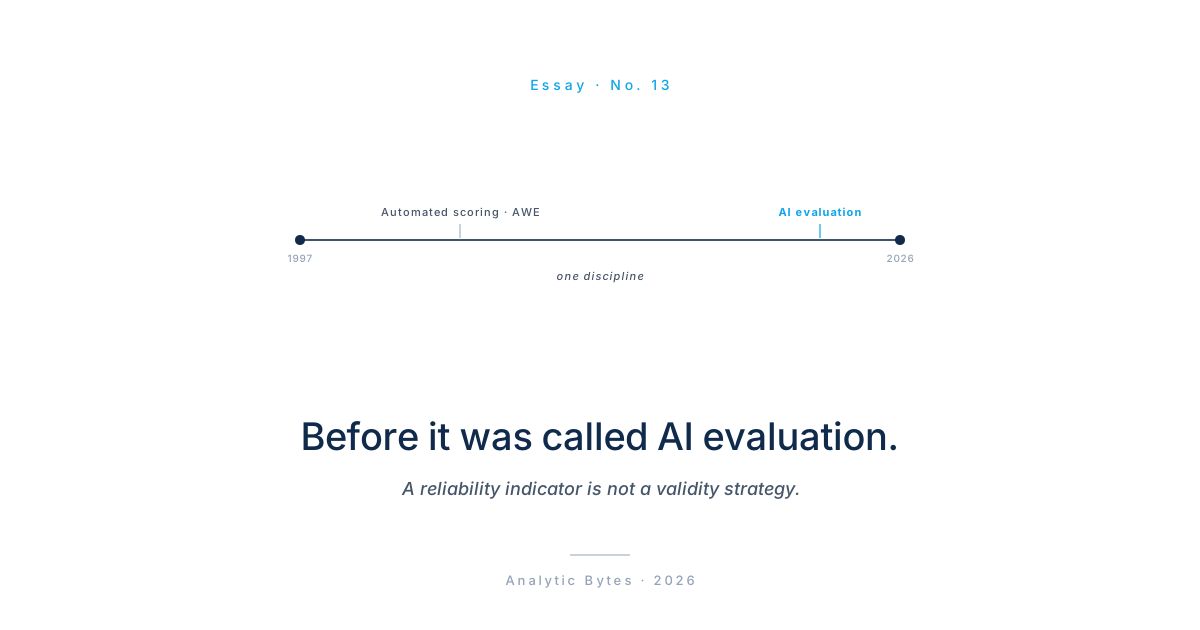
Human-machine agreement is a reliability indicator, not a validity strategy. That claim was in a 2017 manuscript. The infrastructure for what a validity strategy actually looks like — for AI systems, for automated scoring, for any measurement system that stands in for human judgment — was built alongside it. The AI eval field does not need to invent that infrastructure. It needs to find it and turn it toward the systems being built now.
References
Bejar, I. I., Flor, M., Futagi, Y., & Ramineni, C. (2014). On the vulnerability of automated scoring to construct-irrelevant response strategies (CIRS): An illustration. Assessing Writing, 22, 48–59.
Bennett, R. E., & Bejar, I. I. (1997). Validity and automated scoring: It’s not only the scoring. ETS Research Report Series, RR-97-19. (Also published in Educational Measurement: Issues and Practice, 17(4), 9–17, 1998.)
Bridgeman, B., & Ramineni, C. (2017). Design and evaluation of automated writing evaluation models: Relationships with writing in naturalistic settings. Assessing Writing, 34, 62–71.
Higgins, D., Ramineni, C., & Zechner, K. (2015). The use of learner corpora to support automated scoring of test responses. In S. Granger, G. Gilquin, & F. Meunier (Eds.), The Cambridge Handbook of Learner Corpus Research (pp. 587–604). Cambridge University Press.
Kane, M. T. (1992). An argument-based approach to validity. Psychological Bulletin, 112(3), 527–535.
Messick, S. (1995). Validity of psychological assessment: Validation of inferences from persons’ responses and performances as scientific inquiry into score meaning. American Psychologist, 50(9), 741–749.
Ramineni, C. (2015, March). Risks and Rewards of Digital Data: Case of Automated Writing Evaluation. Presentation at the annual Conference on College Composition and Communication, Tampa, FL.
Ramineni, C., Li, C., & Breyer, F. J. (2012, April). Understanding mean score differences between automated and human scores using Classification and Regression Trees. Paper presented at the annual meeting of NCME, Vancouver.
Ramineni, C., Mattar, J., Tessema, A., Li, C., & Schultz, M. (2015, April). Using automated generic scoring models to identify deviant prompts. Paper presented at the annual meeting of NCME, Chicago.
Ramineni, C., Trapani, C., Williamson, D. M., Davey, T., & Bridgeman, B. (2012a). Evaluation of the e-rater scoring engine for the GRE Issue and Argument prompts (ETS RR-12-02). Princeton, NJ: Educational Testing Service.
Ramineni, C., Trapani, C., Williamson, D. M., Davey, T., & Bridgeman, B. (2012b). Evaluation of the e-rater scoring engine for the TOEFL Independent and Integrated prompts (ETS RR-12-06). Princeton, NJ: Educational Testing Service.
Ramineni, C., & Williamson, D. M. (2012). Automated essay scoring: Psychometric guidelines and practices. Assessing Writing, 18(1), 25–39.
Ramineni, C., & Williamson, D. (2018). Understanding mean score differences between the e-rater automated scoring engine and humans for demographically based groups in the GRE General Test (ETS RR-18-12 / GRE Board Research Report 18-01). Princeton, NJ: Educational Testing Service.
Williams, D. R., & Ramineni, C. (2015, April). Using automated features to identify aberrant prompts. Paper presented at the annual meeting of NCME, Chicago.
Written August 2026 for the Analytic Bytes Library. The piece draws on seven years of automated-scoring research produced during my time at Educational Testing Service (2009–2016), with publications appearing between 2012 and 2018, and on the recognition — surfacing repeatedly across the library work of the last few months — that the modern AI evaluation field is rebuilding a discipline the automated-scoring literature already carried. The eight bridges are the ones with citations in my own record; a fuller map of the classical measurement-science literature on this question would run longer.
Questions, pushback, or a problem that looks like this one? Write to chai@analyticbytes.systems.