The mission-driven sector produces a recurring pattern I have watched from inside multiple senior data roles: strong proof of concept, incomplete infrastructure, no runway to production. The idea worked. The dashboard ran. The scale was validated. And then the acquisition happened, or the budget was cut, or the champion left, or the parent company decided the BI costs did not pencil, or the collaborative that was building the shared measurement infrastructure moved at the pace its participating organizations could sustain, which was slower than any single adopting institution could wait.
This is not a story about individual failure. It is a story about a pattern the mission-driven sector runs on. And it is the pattern that AI adoption is now walking into.
The stakes
Enterprise AI adopters and mission-driven AI adopters are fielding the same models. What differs is what happens when a model gets it wrong.
When an enterprise deployment produces a wrong signal, someone loses money, and the enterprise typically has room for a redo — retrain, re-run the pilot, adjust the model. When a mission-driven deployment produces a wrong signal, someone loses the intervention that was supposed to reach them, and the redo is often not available — the funder moves on, the beneficiary window closes, the trust breaks. A behavioral-health chatbot that recommends the wrong framing to an at-risk beneficiary is not a P&L problem. A grant-intelligence tool that suggests reallocation based on drifted metric definitions is not a P&L problem. A program-evaluation AI that generates impact narratives reinforcing sponsor preferences rather than program reality is not a P&L problem. An educational AI tutor adapting to student behavior in ways that reinforce inequitable expectations is not a P&L problem. Each of those is a mission problem, and the distinction between the two matters more than the sector has yet named.
The Reach Trap piece in this library argued that mistaking activity data for outcome data produces misallocation at scale. In AI deployments, the same failure mode shows up one layer up: mistaking model output for validated signal produces mission misallocation at machine cadence. The stakes are different from enterprise stakes, and the responsible-AI frameworks currently being adopted have not yet been tuned to what mission-driven deployments actually risk.
The constraint
Enterprise adopters have built evaluation infrastructure to catch this failure mode: dedicated evaluation teams, red-teaming budgets (paid adversarial testers whose job is to break the model before deployment), machine-learning-engineering (MLE) labs focused on eval infrastructure, safety review boards, and model-quality dashboards. This work is not cheap and it is not fast, but it is investable because the P&L cost of getting it wrong is legible.
Mission-driven organizations cannot replicate this infrastructure at scale. The budgets do not support it. The talent market does not favor them. The staffing pattern I have watched across four institutions is the same one: mission-driven orgs hire data analysts, not evaluation engineers. Larger networks stretch to a senior director for academic reporting or program evaluation, but that role gets consumed by accountability reporting and rarely reaches the measurement-science depth an AI deployment requires: validating that a scale still measures the construct it claims to; running PCA or IRT checks on instruments as the theory of change shifts; monitoring drift between the model’s output and the outcome the model was supposed to predict; watching for when a survey the field has been using for a decade needs to be re-anchored because the population has changed underneath it; watching for when the enrollment model that worked for the last five years no longer predicts because demographic shifts have moved what enrollment looks like in K-12 or higher education post-pandemic. None of that is entry-level work, and none of it is what the sector is hiring for.
There is a layer beneath even this. Before AI can be evaluated, the data it reads has to be governed. Most mission-driven organizations have data. Student information systems, electronic health records, program-management platforms — the operational systems are running and producing records daily. What is often missing is the infrastructure that turns those records into a validated foundation an AI system can read from. The SIS is underused. The EHR is underused. The workflow that would reconcile them into decision-ready data is unfunded. MEL leadership often reads this as “we need to invest in a CRM,” when the actual work is one layer down: the operational systems already carry the signal, but the semantic layer and governance that would make the signal usable never got built. When an AI vendor arrives with a deployment offer, the deployment lands on a data foundation that has never been validated. Every AI evaluation discipline below assumes that foundation is in place. In most mission-driven contexts, it is not.
When there is no funded data infrastructure role, the work gets absorbed by whoever in the organization is capable with numbers or interested in them. A math teacher building professional-development slides. A writing faculty member logging automated-scoring results. A clinician maintaining a caseload tracker. A program coordinator running the grantee spreadsheet. What emerges is an absorption pattern. The primary job (teaching, delivering care, running operations) competes with the absorbed data work, and both suffer. It also produces the spreadsheet sprawl every mission-driven organization has: multiple versions of the same data, maintained by different people, none of it reconcilable at the org level. The distinction between data entry (part of every delivery role) and data curation, integration, and quality assurance (specialized capacity requiring dedicated funding) is where mission-driven org design keeps failing. The absorbed model works until it doesn’t, and when it doesn’t, both the delivery and the data break.
What Is This System Actually Measuring, the earlier piece in this library, named the discipline: measurement validity is what the field has been doing for a hundred years and what AI evaluation is a new application of. WITSAM assumed the reader had institutional research capacity or its equivalent. This piece names what happens when they don’t. The discipline does not go away when the infrastructure to run it is absent. The failure mode does not go away either. It just becomes invisible until the mission drift accumulates and something breaks.
The essential minimum
Given the constraint, the question is not how to build enterprise-grade evaluation inside a mission-driven organization. It is what the minimum discipline looks like when the infrastructure to run enterprise-grade evaluation does not exist. The answer, drawn from the work I have watched succeed and fail across four sectors, is five things.
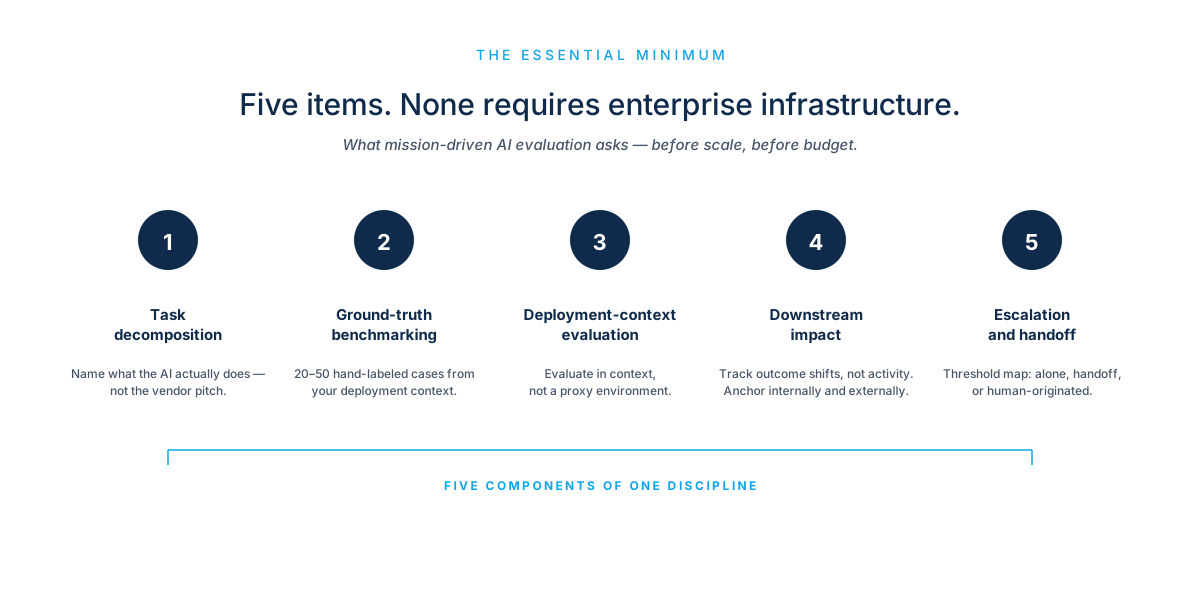
Task decomposition. Before the deployment ships, name what the AI is doing under the hood. Not what the vendor pitch says it does. What the workflow is asking it to do specifically, at what step, with what inputs, and against what standard. This is the WITSAM discipline restated: what is this system measuring, and does that match what we say it measures? A behavioral-health screening chatbot is often doing three things at once: intake triage, symptom classification, and referral recommendation. Each has a different evaluation standard. Naming them separately lets you evaluate each; leaving them fused as “the chatbot” means you evaluate none. Most mission-driven adopters skip this step because the vendor pitch is comfortable and the deployment pressure is real. The cost of skipping it is that no one inside the organization can say what the AI is being evaluated against.
Ground-truth benchmarking with constrained data. Enterprise adopters run large held-out evaluation sets on standardized data they own end to end. Mission-driven adopters usually have neither. Their deployment populations are small — a K-8 network of four hundred students, a CCBHC caseload in the hundreds, a foundation portfolio of forty grantees. Their operational data is messy in ways enterprise benchmarks are engineered against. I saw a version of this at ETS: the measurement framework that worked for GRE and TOEFL at scale did not transfer intact to just-in-time remediation contexts or to writing-validity studies with smaller populations. Even with clean data, moving a validated framework to a new use case required rebuilding parts of it. In mission-driven contexts, the data is neither clean nor standardized, and the framework has to be rebuilt from the smaller sample up. What organizations can do is build the smallest defensible benchmark: twenty to fifty cases from their actual deployment context, hand-labeled by a domain expert, held back from any AI training or fine-tuning. For a K-8 tutor deployment, that benchmark might be thirty real student writing samples the tutor was asked to help with, hand-scored by a teacher against a rubric the network already uses for its own writing curriculum — not synthetic prompts, not vendor-provided examples, but actual samples from the deployment context, labeled by the person whose judgment the AI is meant to support. The benchmark carries diagnostic weight at small n. When the model changes and the benchmark score moves, someone should notice. Refreshing it at every model update is not a special AI cadence. It is the same operational rhythm the organization already runs for accountability reporting or quarterly dashboard refreshes, applied to a new kind of asset. The talent question is not “who will build the evaluation.” It is “who has the data literacy and coaching capacity to keep the rhythm running after the deployment ships.” Without that rhythm, the deployment decays. The frontline absorbs the decay. That is the burnout mechanism mission-driven sectors already know too well.
Deployment-context evaluation. Generic model benchmarks measure generic model behavior. Mission-driven deployments run in contexts generic benchmarks do not represent. A behavioral-health screening chatbot deployed in a rural CCBHC serves a population no public leaderboard reflects. A student-facing tutor deployed in a K-8 charter network serves a population academic AI benchmarks were not built for. Evaluate in context, not in a proxy environment. This is where the small benchmark from the previous step becomes the deployment’s own reference set, not the vendor’s.
Downstream impact evaluation. Are the actions taken based on the AI output producing the intended impact, or drifting from it? This is the Reach Trap discipline applied to AI. Activity metrics (queries answered, sessions run, students triaged) are not outcome metrics. Track what shifts in the mission the deployment was supposed to advance. Anchor that tracking both internally (the organization’s own outcome measures) and externally (public data treated as decision systems, triangulating the quantitative with the qualitative). Internal-only metrics can drift with the deployment; external anchors catch drift that internal instruments cannot. If neither shifts, the deployment is running without earning its keep — even if the model-quality dashboard shows the model is performing well.
Escalation and human-in-the-loop discipline. Where does the AI hand off to a human, and how is that handoff calibrated? Actions, Not Answers argued that agentic AI removes the free human checkpoint and requires organizations to design the checkpoint back in. That argument applies with more force in mission-driven contexts, because the cost of a bad automated action is a person, not a dollar. The threshold map (where may the AI act alone, where must it stop and pass up to a human, where must the human originate the decision) is required for mission-driven deployments. For an advising chatbot: AI may answer “when are drop-add dates.” AI must stop and pass up for “am I on track to graduate.” A human must originate “should I change majors.” Three tiers, published, calibrated by the advising team. Without it, the deployment becomes the failure mode the sector was already at risk of.
Five items. None of them requires enterprise-scale evaluation infrastructure. All of them require the discipline to name what is being evaluated, evaluate it in the deployment context, and design the human checkpoint back in. This is the essential minimum. It is what the sector has to have.
The shared-infrastructure path
Even the essential minimum is more than most mission-driven organizations can build alone.
The behavioral-health sector has been trying a version of this pattern for years. In the Certified Community Behavioral Health Clinic model, participating organizations join collaboratives that establish shared measurement definitions, shared reporting infrastructure, and shared quality benchmarks. The work is painfully slow. The collaboratives meet monthly because every participating organization is running operational work between meetings. Some organizations advance ahead of the collaborative; others lag behind waiting for shared definitions to land; the collective progress moves at the cadence of the slowest participants. But it works. Infrastructure exists at industry scale that no single participating organization could have built.
The pattern generalizes, and the mission-driven AI moment needs it to. If frontier AI adoption in mission-driven contexts is going to happen without producing mission drift, the evaluation infrastructure required to catch drift has to be built as a shared good, jointly by frontier AI providers who benefit from responsible deployment of their models and by philanthropic infrastructure that treats evaluation methodology as sector plumbing rather than proprietary advantage. This is the coordination problem the sector faces, and it is not solvable org by org.
Two flags before this argument lands as easy. Shared infrastructure is champion-dependent, and champions leave. Mission-driven collaboratives have collapsed before, when the chief impact officer or program officer who was carrying the coordination work moved to another role. The durability question, who owns the shared infrastructure after the founder leaves, is the hardest part of the model and the sector has not solved it. And the collaborative model runs at the pace its slowest participants can sustain, which is slower than the model release cadence. That gap is going to widen before it narrows.
One more thing worth naming, because the Center for Effective Philanthropy has just written about it publicly: the facilitation and coordination work that keeps a shared-infrastructure model alive is itself unfunded labor, and its cost is usually absorbed by the same operational leaders already running the mission. When that cost stays invisible, small organizations get excluded from the collaborative because they cannot afford to participate; larger organizations dominate the shared infrastructure, and the eval discipline the model was supposed to build ends up shaped by the contexts of the biggest participants. The intermediary that holds the coordination work (a backbone organization, a third-party facilitator, an embedded eval-methodology lead from the frontier lab’s side) is essential infrastructure. Naming it as overhead is how the whole model collapses — the coordination cost gets absorbed by operational leaders, the same pattern The absorbed data role names one layer down.
Close
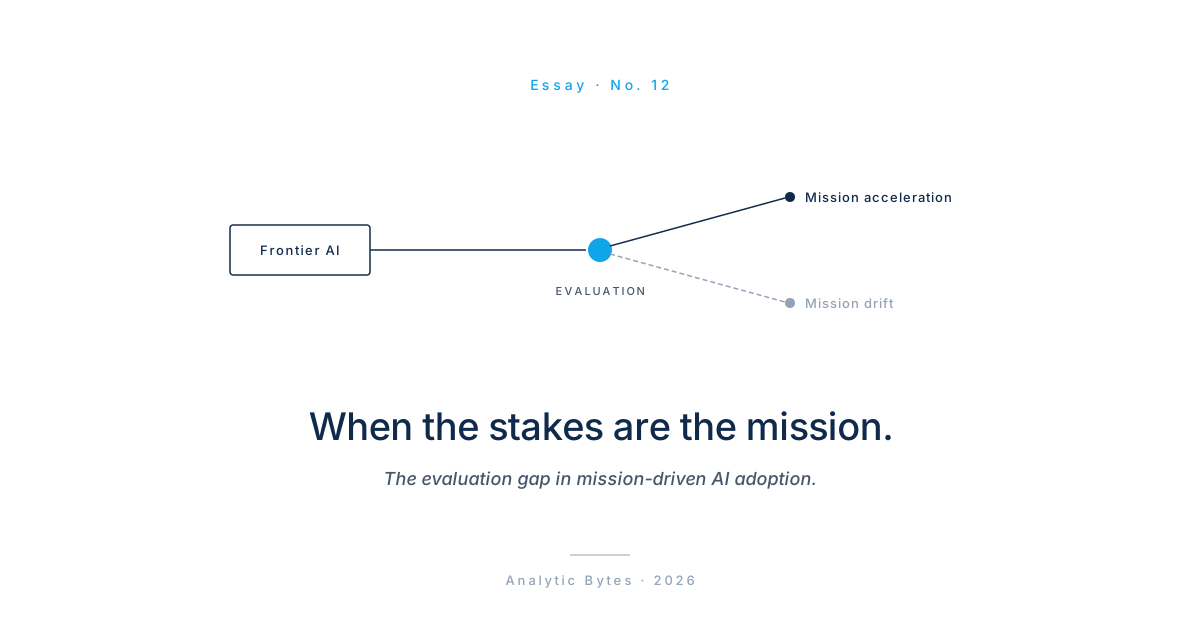
Mission-driven organizations are adopting frontier AI whether the evaluation infrastructure keeps pace or not. Adoption is happening. The question is whether it produces mission acceleration or mission drift. The essential minimum names what has to be true for adoption to earn its keep. The shared-infrastructure path names how the minimum becomes sustainable at sector scale.
Evaluation is what turns a deployed AI into a decision the mission can stand behind. It is the difference between mission acceleration and mission drift.
Written July 2026 for the Analytic Bytes Library. A field-note argument drawn from senior data roles across four mission-driven sectors (K-12 charter networks, behavioral-health CCBHCs, national youth mental-health philanthropy, and educational measurement), and from watching the same evaluation-infrastructure gap surface in each. The five-part load-bearing minimum is what the organizations that have kept AI deployments honest actually run; the shared-infrastructure path is what the sector will need if the essential minimum is going to be sustainable at scale.
Questions, pushback, or a problem that looks like this one? Write to chai@analyticbytes.systems.