Something quiet just changed.
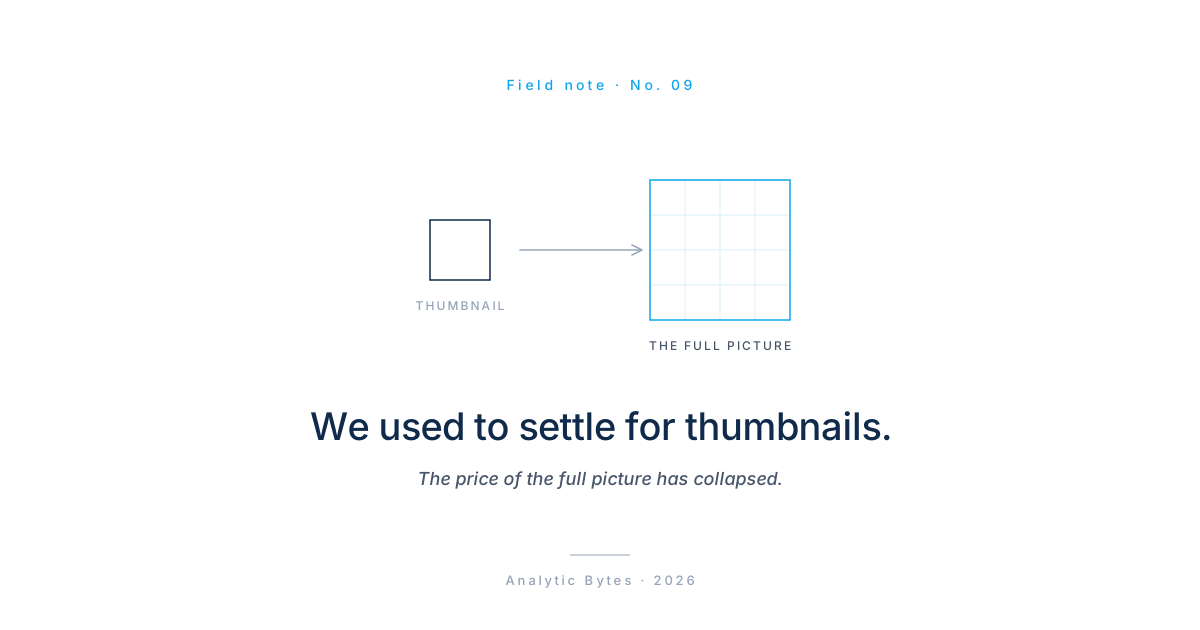
For thousands of years, the bottleneck was carrying the picture. Not anymore. The advisor still has twenty minutes with you. The clinician still has fifty. But what travels into that twenty minutes (what survives the pipeline from intake to conversation) used to be a thumbnail and can now be the full picture. Not because human attention got cheaper. Because the cost of preserving and presenting the picture to the human at the moment of decision finally dropped.
You can think about it the way photography went. We didn’t always have high-resolution images of everything. We had paintings, and only royalty could afford the full likeness. We had early photographs, but they were precious and rare, one shot per occasion, no retakes. Then film got cheap. Then digital got cheap. Then storage and transmission got so cheap that we stopped thinking about it at all. Today your phone holds tens of thousands of full-resolution images and the question is just which ones to look at.
The same thing has just happened to people, inside institutions. The price of the full picture has collapsed.
The choice.
So now every institution faces a choice it didn’t have before.
It can use the discount to sort you faster. More candidates screened, more students flagged, more patients triaged. Same thumbnails: just more of them, generated more quickly. That’s the obvious move, because efficiency has a clear ROI. And the metrics most institutions already track (volume, throughput, latency) reward more of what they’re already doing.
Or it can use the discount to hold you at higher resolution. Same number of students, same number of patients, same number of candidates. But what the advisor opens on her screen is no longer a thumbnail. It’s the picture.
The CEO who says she needs the thumbnail because attention is scarce is not wrong about the constraint. Human attention is still scarce; the picture itself is not an asset unless it has been designed for the moment of decision. A full-resolution view dumped into the advisor’s twenty minutes without curation produces overload, not insight. The discount has to be spent on two things, not one: on preserving the picture, and on designing the interface that lets the picture inform the twenty minutes without overwhelming them. The question is not thumbnail or full picture? It is what does the full picture need to look like for the advisor to use it in twenty minutes? That is a design problem, and it is the second half of what the discount buys.
Most institutions are reaching for the first option. It’s what the dashboards already measure. It’s what procurement already buys. It’s what the consultants already pitch.
The second option requires a different question.
The question.
The question is one a measurement scientist would recognize and one an advisor can carry into any room: does this system actually see the person, or is it still working from a thumbnail?
That’s not sentiment. It’s a measurement standard. The discipline is called validity, and it has decades of track record from the world of high-stakes testing. A score that tracks the construct it claims to measure is valid. A score that tracks something else (length, fluency, demographics, the candidate tested just before you) is not. The standard isn’t new. It’s been ready for this moment for a long time.
What’s new is the price of asking it. When carrying the full picture was impossible, you couldn’t really apply validity to most institutional systems, there was no full picture to validate against. Now you can. And now you should.
The stakes.
For most of history, the thumbnail was the kindest thing an institution could do for you. The full picture wasn’t kept out of cruelty. It was kept out because nobody could carry it.
That isn’t true anymore.
The question for 2026 is whether institutions use the savings to take more thumbnails faster, or to finally stop settling for them.
We used to settle for thumbnails.
We don’t have to anymore.
Written July 2026 for the Analytic Bytes Library. The argument here is compact by design; the longer versions live in companion pieces: What Is This System Actually Measuring? (the validity question applied to an institutional system), The Numbers Don’t Agree Because the Words Don’t (why two systems that both claim to describe the same person disagree), and The Decision System (what the full picture has to look like to inform the twenty minutes without overwhelming them).
Questions, pushback, or a problem that looks like this one? Write to chai@analyticbytes.systems.