I counted the pieces in early August. About 155 of them, across ten layers: voice maps and editorial standards, framework templates, interaction protocols, ops trackers, library maps, scheduled tasks, pinned artifacts, website scaffolding, audio kits, and content corpus. Roughly 76 of the 155 were carrying weight at any given moment. The rest were dormant, deprecated, or waiting.
The first question I had after counting was not whether 155 was too many. It was how many of these were active right now, and how many were already fossils I had not gotten around to retiring. That question is what this field note is about. It sits alongside an earlier piece, My relationship with AI, which named the observation that AI had come to carry weight across professional and personal work, and Auditing an AI-native practice, which put ninety days of numbers on what the layer under my own AI use produces.
The reader I have in mind is another practitioner whose AI use has moved from executing tasks to engineering a system.
The measurement discipline
An accumulated operating layer, on its own, is not what makes this piece worth writing. Second brains have been written about for a decade, and personal knowledge management for longer. What makes an accumulated AI operating layer engineerable — inspectable, revisable, defensible against drift — is a maturity claim rather than a category one. The discipline that lets a practice hit that maturity is measurement design, coupled to the decision layer it feeds. Without that discipline, the layer can still be legitimate knowledge management, legitimate execution infrastructure, legitimate governance. It just will not be engineerable.
Three neighbors it gets confused with, each of which the AB version also contains:
Knowledge management organizes what has been captured so it can be retrieved. Personal AI infrastructure does that too. What counts as carrying weight, what active means, what belongs in the corpus — those particular decisions become measurement questions before they are storage questions, and that is where measurement enters this layer.
Execution infrastructure runs the workflow: schedules a task, drafts a document, ships an output. Personal AI infrastructure runs execution too. Measurement enters when the execution has to justify its recurrence: a scheduled brief that nobody reads is legitimate execution, and a scheduled brief whose read confirms a claim about how the practice is running is what makes the recurrence cost worth carrying.
Governance decides what gets encoded, what gets retired, what happens when two artifacts conflict. Personal AI infrastructure needs governance too. Some governance rules originate in values, legal boundaries, or architectural constraints, and those do not depend on a measurement instrument. Governance rules about lifecycle state or artifact performance are the ones that are difficult to enforce consistently unless the state they govern has been defined and made observable. Those are the ones measurement design carries.
Mark Day, in a May 2026 series on nonprofit AI adoption, argues that scaling individual AI fluency at organizational scale splinters institutional memory into private accounts. That is the same failure mode a single-practitioner operating layer eventually meets from the other side: once enough operating logic accumulates inside one practice, it becomes too large to hold reliably in memory, and the problem organizations face with distributed AI use arrives inside the practice of one. Day is naming a coordination problem across accounts. The version here is a scope problem inside one practice. The failure modes are different; the measurement question these failure modes share — what counts as inspectable, and by whom — surfaces on both sides of the scale.
Torie Williams, writing in June 2026 on enterprise platform architecture, argues that platforms fail from drift, not from mistakes: a long run of individually reasonable decisions, taken under scale, produces incoherence. Her fix is to treat architecture as a decision record rather than a diagram — a living baseline that holds what exists, why it was built that way, and how each choice affects what comes next. A decision record is legible on its own; to make it inspectable, each recorded decision needs a definition of what it counts as, and a signal that would say the practice is still honoring it. Measurement design is what writes those definitions. It is what makes a decision record something a practice can be held to.
Personal AI infrastructure is externalized judgment made retrievable, and measurement design is what makes the judgment engineerable. The unit that matters is the decision, not the artifact holding it. A Voice Map is organized around one governing decision — what “sounds like me” — with many smaller decisions layered under it on phrasing, cadence, and prohibited constructions. What “sounds like me” is a construct in the measurement sense: it can be defined, its edges can be tested against examples that pass and examples that fail, and a draft that violates it can be flagged. That is what makes the Voice Map an instrument rather than an aesthetic preference.
Prompting is a legitimate mode of AI use, and most practitioners spend most of their AI time there. Prompting produces an answer; infrastructure carries decisions across answers. The shift into a practice that accumulates rather than just produces is the shift into infrastructure, and it is also the shift into needing measurement discipline to keep the accumulation inspectable.
Same discipline at three scales
The reason this reads as a discipline rather than an eccentric personal system is that the same move has come up in three unrelated places this year: define what the signal means, name the decision it serves, and build the operating layer around it. Two are client engagements and stay unnamed here; the third is this practice. The three cases I have access to — two anonymized — are a working hypothesis the library will keep testing as more cases arrive.
My own practice. The inventory below is the visible surface. Some artifacts on it are architecture, invocation, or execution and carry no construct at all. The ones that make the practice inspectable — what counts as carrying weight, what counts as absorbed versus embedded, what a Practice Health read is claiming when it says the practice is running well — carry construct definitions. Auditing an AI-native practice introduced HITL and AITL, human-in-the-loop and AI-in-the-loop paired as a signal-informed proxy, for the load-carrier axis of the practice (which decisions carry a human load and which carry an AI load). That is the same measurement move applied to the practice as a whole rather than to a single artifact, and the companion piece is where the proxy’s construct work gets defended.
Analytics infrastructure for an early venture. One thread of client work has been scoping the measurement layer for a venture that has not yet accumulated legacy definitions. Greenfield sharpens the economics: the technical stack has become cheap on its own, and the artifact that stays expensive is a written record of what each metric is a claim about, whose decision it informs, and what would count as evidence the claim was wrong. That written record is the measurement layer, and it is what keeps the pipelines honest a year in.
Execution infrastructure for a higher-ed AI product kit. Another thread has been advising on a kit for staff monitoring their own operational patterns — a setup where the people evaluated also control the closure signal, which is the classic condition that makes self-reported metrics vulnerable. Two measurement moves change the behavior of that kit. Refusal is designed as an output rather than an error state, because at intake the honest answer to some questions is that the evidence is not there. And closure signals are corroborated against a second reading, because a self-reported closure rate becomes a Goodhart trap the moment it becomes a target. Neither move is executed by the workflow; both are the measurement layer keeping the execution layer honest.
The technical work looks different at each scale. The definition of the signal, its tie to a decision, and its built-in check are the same discipline at each. This is the discipline the AB library has been building toward, and this is the piece that names it.
The inventory, and what each layer preserves
The August count, by layer:
| Layer | Items | Carrying weight |
|---|---|---|
| Voice & Editorial | 5 | 3 |
| Framework Templates | 4 | 0 |
| Interaction Protocols | 3 | 3 |
| Ops Tracking | 5 | 3 |
| AB Library Maps | 8 | 0 |
| Scheduled Tasks | 6 | 4 |
| Pinned Artifacts | 18 | 6 |
| Website + Tech Dev | 9 | 6 |
| Audio / Podcast | 9 | 9 |
| Content Kits + Corpus | ~88 | ~42 |
| Total | ~155 | ~76 |
Two layers are worth flagging. Framework Templates shows 4 items and 0 carrying weight, which means I have them but am not currently running against them. AB Library Maps shows 8 items and 0 carrying weight for the same reason. Both are candidates for either revival or retirement, and neither should be counted as active. The distinction between active and dormant is the honest metric on any personal infrastructure, and it is worth keeping in view.
A note on units. The inventory above counts artifacts: one Voice Map, one Editorial Standard, one Knowledge Repo. Some of those artifacts hold many discrete decisions inside them. The Knowledge Repo alone holds roughly 600 entries, and each entry is a small externalized decision about what belongs in the argument. Counting entries would push the total into four figures. I stayed at the artifact level because that is where the distinction between carrying weight and sitting idle is easier to see, but “155 items” is a coarse unit sitting on top of a much larger stack of stored small decisions.
The count also runs generous in the other direction. A single decision often materializes across several layers. Tracking whether the AB library holds together across its disciplines shows up on three surfaces: a Dialogue Maturity Curve pinned artifact, a Dialogue Maturity Dashboard pinned artifact, and a monthly scheduled read that walks both. The task-allocation view is both a pinned artifact and a quarterly scheduled review; the weekly ops review runs against the AB Ops Deck, another pinned artifact plus its scheduled read. When one decision runs on three surfaces, the layer count counts it three times, and the number of distinct decisions still carrying weight is smaller than the number of artifacts carrying it. That is a feature of counting rather than a defect.
Rather than walk all eleven rows, three examples show what the layer as a whole is doing. The distinction that carries through all of them is that producing the pieces of a practice and arranging them so they can be used at the moment of decision are different jobs, and most accumulated systems do the first while assuming they have done the second. Personal infrastructure is that second job at practice scale.
Voice & Editorial — judgment persistence. The Voice Map encodes one judgment about what my voice is versus what Claude’s voice is, and once encoded, that judgment applies to every draft without being reconstructed. A cover letter, an essay opening and a LinkedIn comment all draw on the same encoded criterion. Without this layer the work reads like Claude wrote it, and with it, the work reads like me, drafted through Claude.
Scheduled tasks and interaction protocols — execution persistence. A decision about what should recur, such as a morning reading brief, a weekly ops review, a monthly dialogue-maturity read, or a quarterly task-allocation review, no longer depends on my memory. The decision to have the brief was made once, and the brief now happens regardless of whether I remember to run it. This is the layer that converts intention into infrastructure. It is also the layer where design work is still active, because cadence and timing are being tuned to match how tokens and runs get consumed, and the protocol side, which covers when to invoke a subagent for independent review and when a session runs in a lighter versus heavier mode, is still being written down rather than absorbed.
Content corpus and library maps — context persistence. Prior work remains available to constrain and enrich future work. When I draft a new field note, the Voice Map, the Editorial Standard, the sibling pieces and the AB Landscape are all loadable into the session, so the draft is written against the accumulated context of everything the practice has already established rather than against a blank slate.
Together those three examples name what the eleven layers do, which is to preserve judgment, execution and context across sessions so that each new session does not begin at zero.
How infrastructure forms
The Voice Map took twelve weeks to land. First a draft, then an editorial standard refinement, then micro-gates, then the voice map itself. Along the way the library got two or three rounds of visual and language refinements applied in retrospect. The trigger was the cover letters. They kept coming out not-mine, which is what forced the voice map into existence, which then propagated back through the whole library.
Twelve weeks for one document is a signal. If a single artifact takes that long to stabilize, the practice around it is infrastructure work rather than tool use.
The twelve-week story also tells me how infrastructure gets built. The cover letters produced a recurring judgment problem, which was answering is this mine? every time. That question was expensive cognitively, and it was expensive in output quality on the days I stopped answering it carefully. Externalizing the answer as a document lowered the cost of every future instance of the question. That is the formation mechanism: infrastructure forms where recurring judgment becomes expensive enough to encode.
Not all recurring judgment crosses the threshold. Some judgments are cheap enough to make each time, and encoding them would cost more than skipping them. Others are so context-dependent that a stored rule would misfire more often than it helped. What tips a rule into an artifact is a combination: the same call comes up often, the cost of getting it wrong is real, and keeping the criterion in your head has started to leak into worse output.
I did not set out to build infrastructure. Claude and I were building the practice, and the mechanism above ran the whole time. A cover letter miss triggered a Voice Map. A drift in AB coherence triggered a Landscape. Each artifact is the residue of a decision that had become too expensive to keep making from scratch.
Production and recurrence
The obvious “what changed” story is easy to tell and easy to misattribute. Drafting is no longer the bottleneck. Visuals used to stop me and now they do not. Iteration cost has collapsed, and verification and language grade sit closer to a checked box than an unresolved worry.
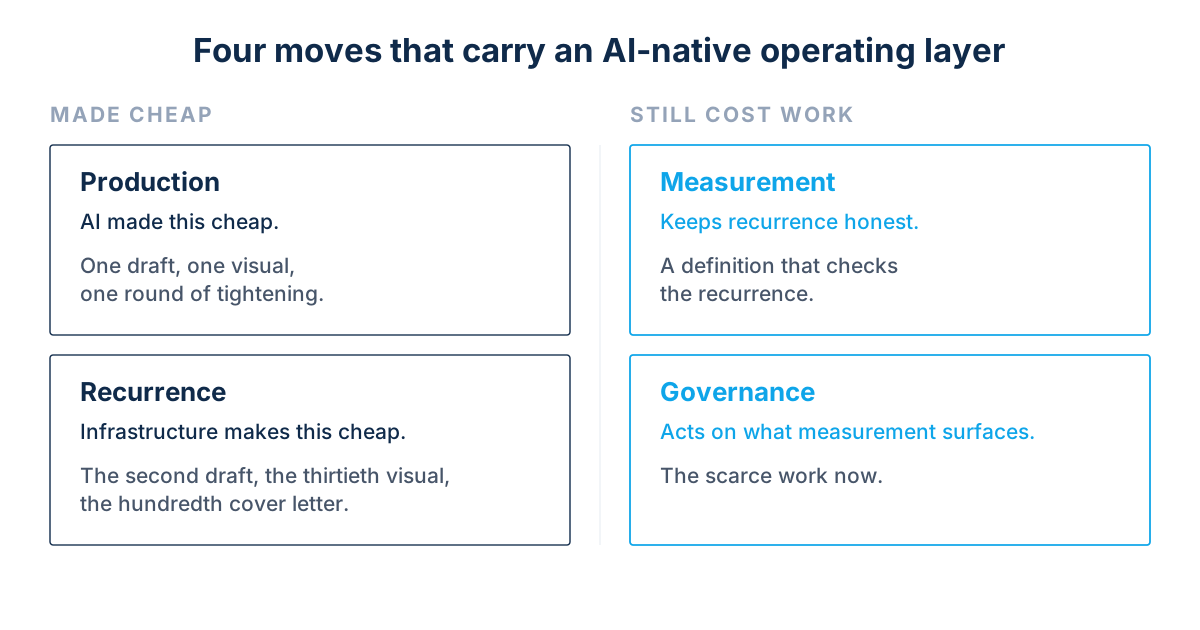
Every one of those benefits is real, but most of them are AI benefits rather than infrastructure benefits. AI lowered the cost of production: one draft, one visual, one round of tightening. That is a big shift on its own, and it does not require any of the 155 artifacts.
Infrastructure does something different. Infrastructure lowers the cost of recurrence, which is the second draft, the thirtieth visual, the hundredth cover letter. AI can help you produce a cover letter; infrastructure means the cover letter inherits your voice decisions without you reconstructing them every time. On the visual side, AI drafts the chart while infrastructure makes sure the thirtieth chart in the library still holds to the color rules and layout logic set during the first ten.
The clearest single-piece test was the AB website: without the Website + Tech Dev layer, the AB library does not exist in a form I would show anyone. The deeper test is the corpus. The published pieces exist, and not one of them required me to re-decide the voice, the editorial standard, or the visual grammar. That is the recurrence economy, where infrastructure earns its cost.
Distinguishing the two economies is what makes the case for infrastructure honest. If AI is doing the lift on production and infrastructure is not doing anything on recurrence, the infrastructure is decorative. If both are doing work and I can name what each is doing, the infrastructure justifies its keep.
Two more moves complete the picture. Measurement keeps recurrence honest — the thirtieth chart passes the audit because there is a definition to check it against. Governance acts on what measurement surfaces: an artifact whose recurrence has stopped earning its keep gets moved to dormant, embedded, or retired based on which reading of the practice explains why. AI made production cheap and it landed everywhere. Infrastructure makes recurrence cheap, and it is what an accumulated operating layer contributes. Measurement and governance are the two that still cost real work, and the piece below is about what that work looks like inside one practice.
Six conditions an artifact can occupy
Krish Adavi’s August 2026 piece The Untracked File names a version of the same failure mode at agent-memory scale: a codebase written continuously and reviewed never. He identifies four degradation paths — staleness, compaction loss, contradiction, provenance blur — and proposes five remediation patterns focused on version-control-style hygiene. The six conditions below extend that observation from an agent’s memory store to a practitioner’s operating layer, and add two categories his review-frequency framing does not need. Embedded and absorbed are governance categories: they describe artifacts whose retirement or continued presence has to be decided rather than debugged.
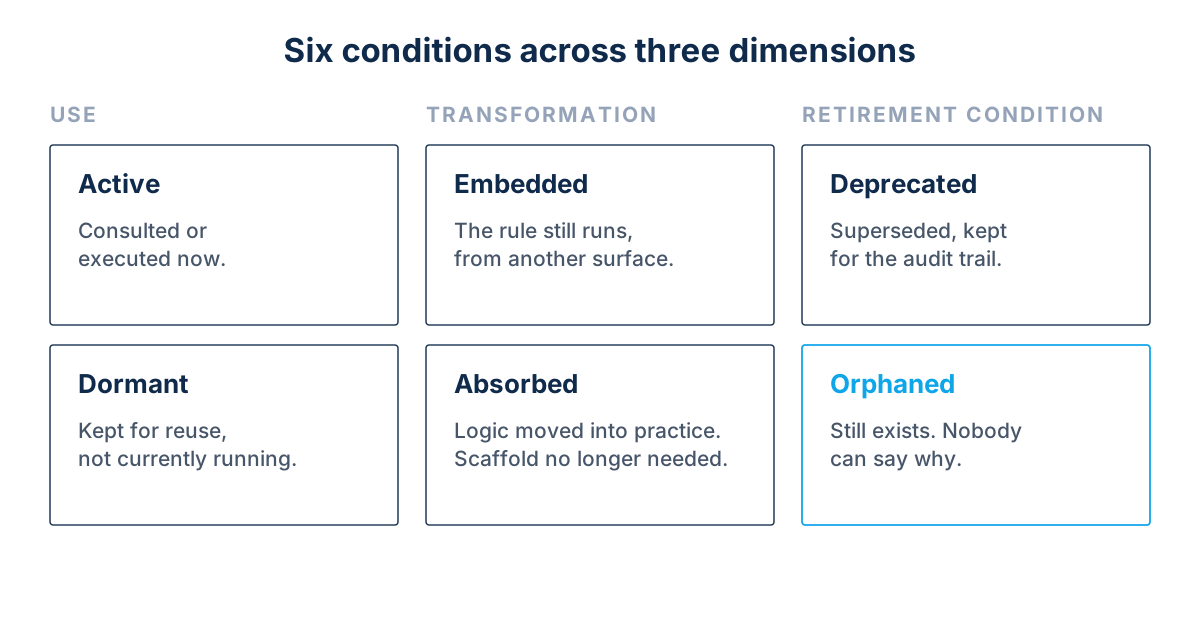
These are not a linear lifecycle. They are three dimensions collapsed into one useful list — use (active or dormant), transformation (embedded or absorbed), and retirement condition (deprecated or orphaned) — and they overlap in practice. An embedded rule can be actively invoked, and a dormant artifact can already be deprecated. The list is the language for reading a single artifact against multiple axes, not a track it walks along:
Active. Consulted or executed now. The Voice Map when I open a draft, the Monday brief when Monday comes. About 76 of the 155 in the August count.
Dormant. Retained for possible reuse. Not currently running against, but the decision it encodes is still recognized. Framework Templates sit here, and the AB Library Maps sit here between refresh cycles.
Embedded. Invocation has moved into another running system, though the rule itself still explicitly executes. The clearest recent instance is Skills. Between the August count and now, several artifacts that had been carrying weight moved into an installed-skill form: the Voice Map became a chaitanya-voice skill and the Editorial Standard became an ab-editorial-standard skill, alongside embeddings of the session-start hygiene rule and the morning brief. The original documents did not disappear, but the trigger did. What used to require me to remember to load a rule now loads itself when the conditions match. Embedding migrates invocation from manual to automatic and leaves the artifact and its rule in place, which is what makes it a state distinct from retirement.
Absorbed. The logic has propagated into practice or into downstream artifacts, and no explicit rule needs to carry it anymore. Early landscape sketches whose taxonomy is now inside the library structure itself sit here, and so do early framework templates whose logic is inside the editorial standard. Absorbed is the state where removing the original scaffold changes nothing, because the scaffold is not what is running the practice anymore.
Deprecated. Explicitly superseded, and kept for audit trail or deleted. The prior version of the Editorial Standard before the 2026-08-19 amendment on Gate 5 sits here.
Orphaned. Still exists but nobody, including me, knows why. This is the failure state to catch, and every audit turns some of these up.
The reason the distinctions matter is that “fossils” was doing too much work in my head. Not all fossils are orphans. Some are absorbed, which is to say their logic has propagated into the practice and their scaffold is no longer needed to carry it. Some are embedded, which means the rule still runs but from another surface. Others are orphans that exist because retirement takes effort. The move the language makes possible is not “leave the absorbed alone” — an absorbed scaffold is often safe to archive once its provenance has been captured — but “do not mistake absorbed infrastructure for orphaned infrastructure.” One did its job. The other never had one that anyone can name.
That also changes what carrying weight means. Carrying weight is different from being frequently used. Some artifacts are consulted daily but easy to reconstruct if lost. Others are consulted rarely but catastrophic to lose because the judgment they hold is not written down anywhere else. The 76 count I have been carrying is a rough proxy for active, and it is not yet a proxy for what would cost me if it disappeared.
Is 155 too many?
I recounted in mid-September, before finishing this piece. The numbers moved, and the argument did not.
The corpus layer nearly doubled: 44 live essay markdowns now sit inside a larger kit-plus-syntheses stack that drove the growth. Skills became its own layer with about six AB-relevant entries plus a handful of format skills. Scheduled tasks look smaller on paper, with five recurring tasks now rather than six, but that is not decay. It is the cadence tuning I mentioned above, running toward fewer, better-timed executions rather than more. The Framework Templates and AB Library Maps layers are still where they were: present, structurally important when consulted, currently dormant against the day-to-day flow. And the Knowledge Repo, which the earlier count treated as one artifact, has grown past 600 entries.
The rough recount comes to roughly 230 artifacts and roughly 100 carrying weight, across eleven layers rather than ten. The carrying-weight share drifted — around 49 percent in August and closer to 43 percent now — because the corpus and skills layers grew faster than they immediately activated. That is a signal worth watching rather than a problem on its own; accumulation outrunning activation for a few weeks is what growth usually looks like. The stronger evidence of whether governance is keeping up sits in the audit instruments and in whether the retirement cycle is running, and I come back to both below.
The number sounds big, but 230 items with 100 carrying weight is a different practice than 230 items with 230 carrying weight.
The signal that would tell me I have crossed into optimize-phase is the ratio of my time, not the count. If I am spending too much time getting organized and not enough time exploring, discovering or developing new ideas, the infrastructure has stopped serving the practice and started consuming it. I have not hit that inflection yet. I check for sprawl regularly, and in the last four weeks I have checked more often.
Part of what lets me answer this at all is that self-audit has itself become a small set of surfaces. AB Practice Health, the CNS view, the Cowork Command Library, and AB Library Sentence Metrics are pinned artifacts built specifically for looking at the practice from angles other than “am I getting work done today?” Practice Health reads how the practice is running. The CNS view reads whether the AB library circulates across its disciplines or sits as fragmented islands. The Cowork Command Library reads which commands and moves are in use. And Sentence Metrics reads whether the language of the library is drifting. The instruments are recent and I am still learning to read them, but their existence is itself part of the answer to whether governance is keeping up with infrastructure. When you build the instruments for watching your own accumulation, you have crossed from just building to building-plus-observing.
Two disciplines from the surrounding field are worth borrowing.
Bridgespan’s practitioner guide to nonprofit MEL, written by Searle and colleagues and published in early 2025, is one of the clearest recent restatements of the decision-use test, and most of its advice is subtractive. It tells organizations to collect less, gives explicit conditions for not commissioning an evaluation at all, and screens every proposed metric through a decision question rather than a feasibility one. Its governing test is “what decision can’t we make because we are missing this information today?” That is the discipline personal AI infrastructure needs too. The default is not toward adding a template, a scheduled task or a tracker, but toward asking whether the new piece will change a decision I am about to make.
And Dani Beam, writing in July 2026 on Chesterton’s Fence in nonprofit strategic planning, cautions against the opposite mistake, which is cutting things you do not understand. A practice that nobody can explain is often not a practice nobody needs. It is an encoded response to a problem that will re-emerge if the practice goes. Some of the roughly 100 that are carrying weight right now carry it because an absorbed piece did its job long ago and its logic is still running in the artifacts that replaced it.
Together the two disciplines say retire the orphans, do not mistake absorbed pieces for orphans, and do not add unless the decision behind the addition will recur.
Measurement, decision, and the operating layer
Building the 155 pieces was infrastructure work. Deciding which of them are active, dormant, embedded, absorbed, deprecated or orphaned is governance work. That governance work needs a measurement layer beside it, because the states it acts on are the ones measurement had to define first. Active, dormant, embedded, absorbed and orphaned are governance categories the taxonomy has made observable, and observability is what a governance rule uses to act on a state.
The failure mode the six conditions exist to catch is the one where recurrence keeps running but nobody reads its output, artifacts still occupy the count of pieces that should be carrying weight long after the decision they served has moved elsewhere, and no one instrument is watching whether the recurrence still earns its cost. Governance and measurement do not stack for this failure; they interact. Governance cannot act on a state it cannot see, and measurement can see the failure without any authority to fix it. AI made accumulation cheap and has not yet made either measurement or governance cheap, and that is what makes personal AI infrastructure a governance problem an individual has started inheriting at a scale that used to belong only to organizations.
The number that matters is not 155 and not 230. It is the roughly 100 artifacts still carrying decisions for me right now, and the smaller number of distinct decisions inside them once double-counting is removed. Some will go dormant, some will become embedded in other running systems, some will get absorbed into practice or downstream structure, and some will end up as orphans that need to be retired.
Once AI made accumulation cheap, judgment about the accumulation became scarce. What keeps that judgment defensible is a measurement layer that lets the operating layer inspect its own claims — consequential judgments made explicit enough to inspect, their decision use named, and instruments capable of detecting when recurrence no longer earns its cost. Sometimes those constructs are prospective; often they are extracted from friction the practice has already run into, the way the Voice Map came out of twelve weeks of not-mine cover letters. Either way, without those pieces the layer can accumulate but cannot inspect itself. Measurement is what turns recurrence from habit into something that can be challenged.
The piece that comes next in this arc is Gates and workflows, and its job is to open the layer below the inventory. Where this piece names what the practice holds and how the pieces relate, Gates and workflows names what a single working session runs against — which workflow is human-in-the-loop, which is AI-in-the-loop, and how HITL and AITL together track the load-carrier axis Auditing an AI-native practice introduced. Measurement design informs the gate specification, the gate specification informs the workflow, and the workflow is what the operating layer executes.
Written September 2026 for the Analytic Bytes Library and published in October. The inventory is my own: about 155 pieces counted across my working folders in early August 2026, with the ten layers and the six conditions drawn from that count rather than from a published taxonomy. The two external arguments are Mark Day’s May 2026 series on nonprofit AI adoption and Torie Williams’s June 2026 writing on enterprise platform architecture; both are used as parallels to the single-practitioner case, not as evidence for the count itself. No employer, client or funder is named, and every seat is described by role. Gates and workflows is named in the close as the next piece in this arc and is not yet published, so it is named rather than linked.
Questions, pushback, or a problem that looks like this one? Write to chai@analyticbytes.systems.