At one school network I worked with, I learned to administer PowerSchool by booking one-on-one hours with a technical support rep at the vendor. He was patient and he was kind. He kept extending our sessions, giving me more time than the package was built to provide, so I could keep going without running the ticket dry. What those hours bought was the configuration depth a student information system (SIS) like PowerSchool, or an EHR in a clinic, holds — the reporting layer, and SQL extraction run straight against the database. Onboarding does not reach that. Neither does ops training, which teaches the workflow rather than the system that supports it. I was the person who was going to be running the system for a network of schools, and the way that skill entered the building was one hour at a time on a screen-share, from a rep who was quietly giving more than the package was built to provide.
I want to hold on to that image because it is the whole essay. Nothing about the vendor was wrong. The support was real; the rep gave more time than the package was built to provide; and the tool did most of what it was sold to do. The reason I was on those calls at all was that the system had to be run by someone who held the school’s definitions in their head; that person had to be me, and nobody at the vendor could do that part. What he could teach was how to work the platform all the way down, into the configurations that decide what the system can be asked. What he could not teach was what enrolled meant here.
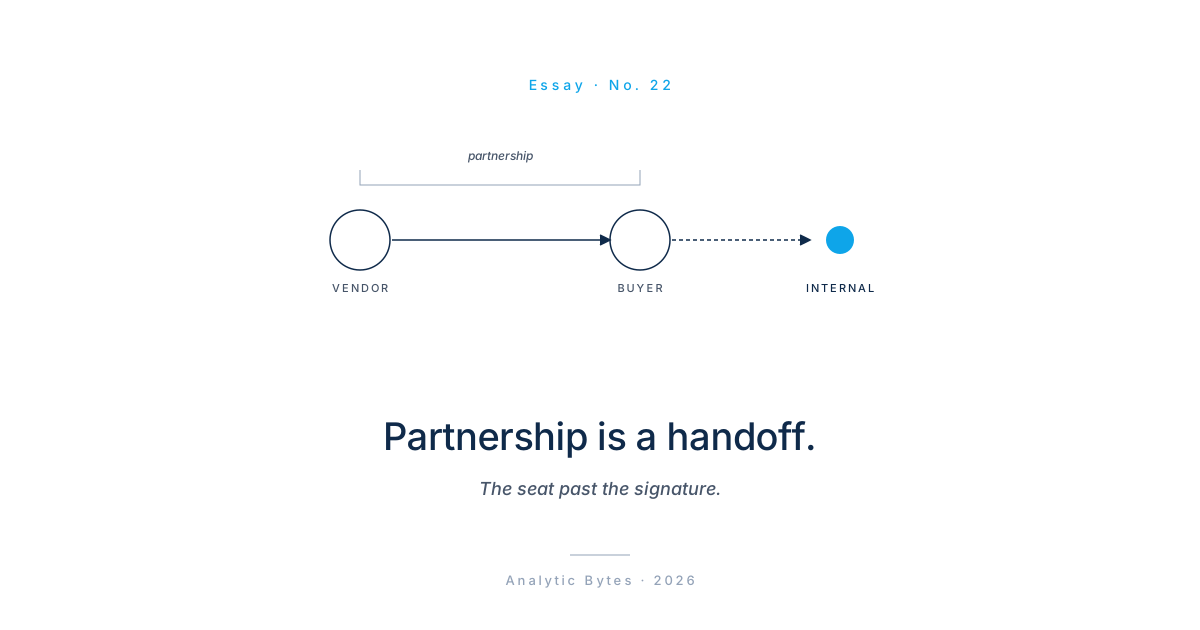
Vendors talk about partnership. What partnership names, most of the time, is labor the vendor cannot supply and the buyer’s team must absorb.
Marketing research has mapped who does the buying inside an organization since the early 1970s. Webster and Wind’s buying center named five roles that shape a purchase decision: users, influencers, buyers, deciders and gatekeepers (Webster & Wind, Journal of Marketing, 1972). That map runs from the seller’s side, up to the signature. This essay follows the same cast past the signature, from the buyer’s side, where the labor lands.
The stack of partners
The handoff runs through three different relationships, and holding them apart matters. Only some of them explicitly call themselves partnerships, but the labor mechanism runs through all three. There is the transactional vendor who sells you a tool (a student information system, a CRM) and offers support because the contract requires it, without pretending to share your outcome. There is the strategic partner who claims to share your outcome, often with compensation tied to a metric: outcomes-based contracts, some ed-tech providers, some funder-and-technical-assistance relationships. And there is the consultant or service provider you bring in to do work — a marketing consultant, an implementation partner, a strategy firm — whose own deliverable depends on data your systems already carry. The labor transfer runs through all three. Partnership language is what makes the transfer feel like a shared achievement rather than a purchase.
You buy the tool. The vendor assigns a customer success manager (CSM), and often a technical solutions manager; workshops, trainings and a ticket queue come with the contract. All of that is real and often responsive. Then you find out that the CSM cannot configure the tool to your org’s use cases on her own. Onboarding packages bundle a small block of implementation time with her, usually for one demonstration use case or the most urgent configuration problems; past that is hourly, and for a platform like Salesforce the vendor’s own team will often recommend a third-party implementation partner because the configuration surface is wider than the bundled hours can carry. So you contract that partner: a third-party services firm that logs into your instance and sets up the data sheets and the field structure. The partner handles the configuration work. What they still cannot do is sit in the meetings where your definitions get argued about, because your use cases live in the head of whoever runs the program.
Then you find out that the implementation partner cannot maintain the instance once they hand it over, because they do not sit in the meetings where the definitions get argued about. So you hire an internal associate to manage it. That is a third role, funded because the second vendor could not do the work.
Then you find out that the internal associate cannot answer the question your CEO asked on Tuesday, because the associate does not hold the twenty pieces of context that make the question mean what it means. So you open a spreadsheet and answer it there, so that the report goes out on time. That is where you started, and now there are four people between you and the answer, and the answer is in a spreadsheet.
Each of those layers was sold as a way to reduce the load. Each did take away a piece of the work. What none of them eliminated was the need for someone internal to hold the pieces together, and every new layer added an interface for that person to manage.
The piece that stays internal
That piece is org logic.
The working definition is the one the org uses day to day, which rarely matches the field the vendor built. Enrolled at your school is not what the SIS counts, because the summer program feeds in before the year starts and the state’s cutoff moved. Engaged in your case-management system is not what the system’s field counts, because the funder wants two touchpoints a month and your clinicians know a text at 10pm is not the same as a call at 3pm. In the funnel in your CRM is not what the CRM column counts, because the advancement team is small and half the leads live in the executive director’s inbox.
A vendor’s team can inform any of it, and a good one will — the vendor’s people help you reason through what a definition should be all the time. What no vendor can do is resolve an org question on the org’s behalf. The tool questions belong to the vendor. The org questions stay with you.
This is the mechanism The absorbed data role names as the missing funded seat, and The delta nobody budgeted names as change maintenance. Both are about the same absence. This piece is about what fills the absence rhetorically, from the outside, which is the language of partnership.
The vendors know this, even when the language they use out loud is partnership. Once I had been running PowerSchool for a while at the same network, the vendor’s account team stopped routing questions through the executive who had signed the contract and started calling me directly. I was not the customer of record. I was the person who could answer whether a proposed configuration would break something on Monday, and they had figured that out on their own. HubSpot did the same at another organization I ran systems for; the account manager worked out within a quarter that the person on the receiving end of her calls could not answer her questions, and I could. The marketing consultant at the same network figured out the same thing: within her first few weeks she had worked out who could pull the data she needed, and she stopped routing the ask through the COO. What that pattern is honest about is where the work lives. The account-level partnership eventually resolves into a person-level dependency: the vendor learns who inside the org actually carries the definitions, and it is that person the vendor calls.
What partnership cannot see
When a vendor speaks to the organization, the organization is often six or seven people, and the person who signs is rarely the person who will run the tool. Some of this the vendor’s customer-success team learns on its own — the account record has a name inside a quarter, and the name on the line is rarely the name on the signature. What the vendor doesn’t see is a rougher shape moving inside the buyer’s building, which only shows up when the work stalls.
At the same network, a COO brought in a marketing consultant to hit enrollment targets. The consultant asked for the standard marketing numbers. Where inquiries came from. Which campaigns converted. How many families attended an event. Where families dropped out of the application funnel. How many current families planned to return. Those answers were the inputs to every decision the consultant had been hired to make about budget, ads and spend.
Nobody could supply them. The data existed, but it sat in three systems that did not talk to each other — HubSpot for prospects, SchoolMint for applications, PowerSchool for current families — and the CRM had never been fully set up. When the consultant could not deliver, each seat in the room had its own account of why. The COO said the work needed more budget. The enrollment manager said it needed more headcount, to set up the CRM properly and to run the campaigns, the Mailchimp sends and the tabling. The superintendent, pulled in by the CEO as the school-side leader, said plainly that they had never done enrollment or marketing and did not know, and that pulling school leaders in would take them off their work with students. The junior associates kept chugging away at manual data entry, email campaigns and phone outreach.
Every answer was true, and that was what made the round hard to break. Budget is the COO’s lane. Headcount is the manager’s. Experience and protecting academic time are the superintendent’s. Each person named the resource their own seat would need to do more, and each was right about their own seat. What nobody named was the join. The consultant’s questions could only be answered by pulling records out of three systems and matching them, and the join was not in anyone’s job. It went, as it usually does, to the seat that could carry it — the data lead’s, on top of her compliance and academic reporting work, with hands borrowed from network ops and part-time associates. Because no single system held what the consultant needed, they stood up a stack of worksheets outside the CRM: event attendance, email campaign click rates, call outcomes, lead sources, prior-year withdrawals, abandoned applications in SchoolMint. The consultant kept proposing conditionally: if that data were available, this is what we could do with it. The doing often fell to the internal team too, including follow-ups on abandoned applications and outreach to prior-year families, because the consultant could not run on data that was still being assembled. The blame for the consultant’s results came back to the internal team, for not supplying what the consultant had asked for.
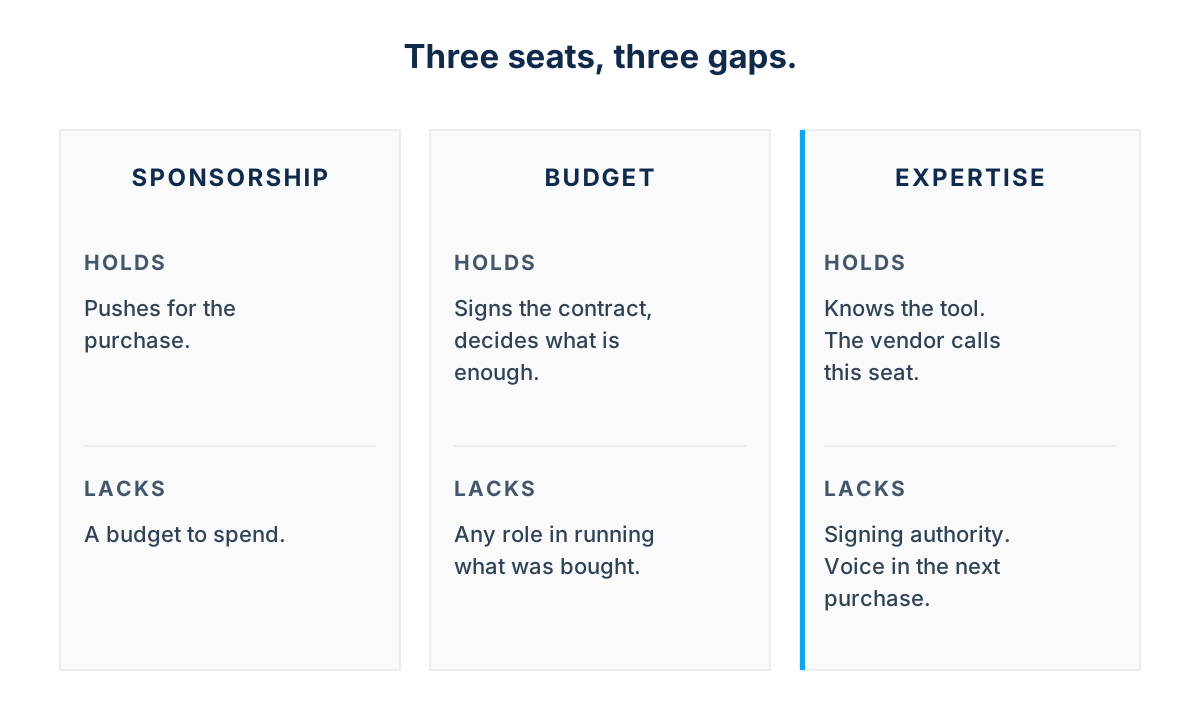
That is the shape a partnership frame does not carry. Three kinds of authority sit in three different seats. Sponsorship, the push for the purchase, often sits with someone who has no budget. The budget sits with someone who signs the contract and decides what is enough, without running the system. The expertise — knowing the tool well enough to catch problems — sits with the running seat: the vendor calls that seat, the executive team trusts its outputs, and it has no signing authority or voice in what the next purchase will be. In a small nonprofit the three can collapse into a single executive director who sponsors, signs and runs. In every organization larger than that, they rarely do; a vendor’s contract still speaks to the organization as one party. The seat that catches the handoff often catches it without a say in what was bought.
The tier with no partner at all
Some systems do not even come with the offer.
There are tools your organization uses every day where the workflow is still manual, usually because nobody internal has the integration know-how to connect what the vendor offers to the systems you have. The National Student Clearinghouse’s StudentTracker workflow at the school-user tier. Applicant tracking systems in the same tier. Some state systems that release data as fixed PDFs. To use these, someone on your team logs in every day, checks whether new records arrived, transfers them into your student information system by hand, and matches them against the roster in a spreadsheet because the fields do not line up. It is the same absorbed seat from For the record., taking the round trip manually because no automated round trip exists.
Nobody promises partnership here, because there is no one on the other side. The load is visible here. No partnership rhetoric hides it. But it still sits on the same absorbed seat, because no role scope names it as its own line of work. The system is honest about requiring manual labor. The labor still lands on the person who was already carrying the rest.
Both tiers point to the same thing from opposite directions. A friendly vendor’s CSM and workshops add responsiveness and reduce how many hours of internal work remain. An unfriendly vendor’s silence does neither — but at least makes the internal burden visible as what it is. In both cases, there is a category of work that cannot leave the organization: the piece that depends on org logic. Support changes the quantity. The category stays inside.
The buyer runs the training too
There is one more layer of the handoff that the vendor’s own materials do not name. The vendor sells professional development, ships onboarding videos, runs webinars, and lists training as part of the package. Inside the org, once a knowledgeable internal person has been running the tool for a while, much of that vendor material gets replaced at scale by locally-made versions. What gets used are the videos and sheets that person made herself, in the org’s own vocabulary, showing the ten fields that matter.
At the same network, the person who signed the vendor contracts made a call in later years that the vendor’s own trainings were more than the school needed. Print grade reports, log attendance, run the basic longitudinal pull — that was the working set, and there was already someone internal who had distilled the vendor’s material into short videos and sheets for the front office. The choice was a functional adaptation and it saved the school real money. What it did was move the training function from the vendor’s line item to the internal person’s uncounted hours, and neither the contract nor the org chart recorded that the shift had happened.
Partnership language covers the running, the configuration, the training, and the interpretation. Every layer requires local translation from generic capability into what this specific school does on Tuesday, and only someone internal can do that translation. The vendor’s material stays generic because it has to. The org’s real training material is the local translation, which lives as a folder of screen recordings on someone’s Drive. When that person leaves, so does the translation.
The training labor runs further out than the vendor’s own materials. You buy hours from the vendor’s solutions architect. You attend the community of practice the vendor organizes for its customers, or the one an adjacent foundation convenes for the sector — CSGF for charter networks, similar cohorts in behavioral health and higher ed. You receive the playbook and the templates and the deck. You send 1:1 outreach to peers in other organizations who look like they might have figured out the piece you are stuck on. Every one of those channels is real, and most are generous. Almost all of them are still organized around the same vendor ecosystem you already bought into. The ecosystem is rich with knowledge and thin on operationalization, and the operationalization is yours.
When the measurement ask is the partner
The pattern is not vendor-only. Funders and technical assistance (TA) organizations run it too, and the seat I have sat in has been on both sides.
I have watched an organization I worked for issue long overlapping surveys to schools, sections of which could go to different teams inside a school, none of which mapped to a single system the school already ran. Meanwhile the schools were completing compliance reports for the state, outcomes reports for other funders, and a separate parent-and-student survey they had already licensed from a measurement vendor. The overlap was not checked. The redundancy was not priced. The design assumed the school had a person whose job was to answer surveys, and no school I have worked in has that person.
The language around this kind of ask is often partnership. We are your partner in improvement. We are learning alongside you. That language describes the funder’s or the TA org’s own experience of the relationship. On the school side, it reads as one more request from a party that does not have to do the filling-out themselves. Every partnership promise moves labor. This one moves it from the funder’s evaluation team to the school’s front office.
Kelly Sia, the CEO of Curriculum Associates, made the same partnership argument recently in The 74, this time about outcomes-based contracting (OBC): the contract creates accountability, the partnership creates improvement, both sides align around student success (Sia, The 74, September 11, 2026). OBC as a model was designed to fix the exact vendor-accountability problem this essay is describing. It emerged from Tom Kane’s work at Harvard’s Center for Education Policy Research in the early 2020s and is now housed at the Southern Education Foundation’s Center for Outcomes Based Contracting, with the stated purpose of tying vendor payment to student outcomes because more than 65 percent of purchased ed-tech licenses typically go unused and traditional contracts create no financial consequence for that underuse (What is Outcomes Based Contracting? — Center for OBC; Toppo, The 74, April 6, 2026).
Read closely, Sia’s specific recommendation is that rather than expecting every enrolled student to achieve the same outcome, districts and providers should measure “overall class or school-level growth, such as the median percentage of progress toward each growth target,” because holding a vendor to every enrolled student meeting a target is unrealistic (Sia, same article). From the district seat, that reads as the vendor writing the accountability definition. The redefinition softens vendor exposure while keeping the language of shared accountability, and it does that at exactly the point where the district would need a funded measurement seat to negotiate a definition of its own. Sia’s other recommendations to districts — regular governance meetings, shared data reviews, continuous course correction — are the labor this essay is naming, presented as though nobody had to pay for it. OBC was designed to fix vendor accountability; what Sia’s argument shows is how quickly the definition can be redefined from inside the vendor tier once partnership language is on the table. Where the district has no funded measurement seat, the vendor’s proposed outcome definition arrives with no equally equipped institutional counterparty, and partnership becomes a longer word for one-sided accounting.
What reduces the load
This starts, most of the time, as a build-versus-buy decision, and it loses track of the seam. The build option was rejected because it required internal capacity nobody wanted to fund. The buy option was chosen because it appeared to eliminate that requirement. Neither was true. Buy did not eliminate the internal capacity requirement. It moved it from the labor of building the tool to the labor of bending internal knowledge to fit the tool the vendor built for everyone. That second labor is not zero, and it rarely appears in the purchase decision at its full internal cost.
The field’s usual repair is to ask for more professional development or a longer support contract. That is the wrong repair. It buys more of the same category of thing the vendor already supplies, when the missing capacity is local translation on the buyer’s side. More support can improve the vendor side of the seam. It cannot staff the buyer side of it.
Three things reduce the load, and none of them is a better partnership.
The first is naming the labor and pricing it. When you buy a tool, the invisible labor is the internal person who translates org logic into system configuration and back, every day, forever. If the purchase case does not name that labor, the organization is approving a partial cost. If your board’s budget does not name it, your board is approving that partial cost knowingly. The remedy is not a stronger CSM. It is a line item on your side that says: this system requires N hours a week of an internal role that holds our definitions. Fund it or do not buy the system. This is the same argument The absorbed data role makes for the specialized bucket-3 seat, run against the vendor conversation instead of the org chart.
The second is that measurement asks respect what is already running. Before a funder or a TA organization designs a survey, they should ask: what does the school already field, and can our question ride on that instrument or that submission. If it cannot, the ask has a cost, and the cost belongs on the party making the ask, not on the school. That takes the form of a shorter instrument, a shared administration, or a stipend to the school for the additional staff time. The third is naming the seam before signing. Every purchase creates a seam between what the vendor supplies and what the org must supply to make the vendor’s product usable. The build-versus-buy decision loses track of that seam because the buy option is priced as though the seam did not exist. A vendor contract that names the seam explicitly — what the vendor owns, what the buyer owns, and which internal seat holds the join once the contract is live — is a contract that acknowledges the internal role instead of pretending it away. When measurement arrives after the build takes the vendor’s side of that seam.
Partnership language without a labor accounting is a rhetorical move. Partnership language with a labor accounting is a contract.
The rep who gave more time
The PowerSchool rep who gave me more time than the package was built to provide was doing what he could. He knew what the load looked like from where he was sitting, and he tried to reduce it by giving me his own time back. I remember him with real affection, and I think about him often when a vendor tells me they are my partner. He is what it looks like when one person on the vendor side sees the seam the commercial arrangement failed to price. Almost nobody talks that way in a sales conversation. Almost every buyer’s team is carrying the difference.
Written October 2026 for the Analytic Bytes Library. No employer, client or vendor relationship is named beyond products in general use; every seat is described by role and in de-identified form, per standing practice. The PowerSchool support hours, the three-system enrollment case and the stalled consultant engagement are from the author’s own record. External sources were verified against their live pages in October 2026: Webster and Wind (1972) read from the published paper rather than a summary, and the outcomes-based contracting material read from the Center for OBC’s own pages alongside the two reports in The 74.
Questions, pushback, or a problem that looks like this one? Write to chai@analyticbytes.systems.