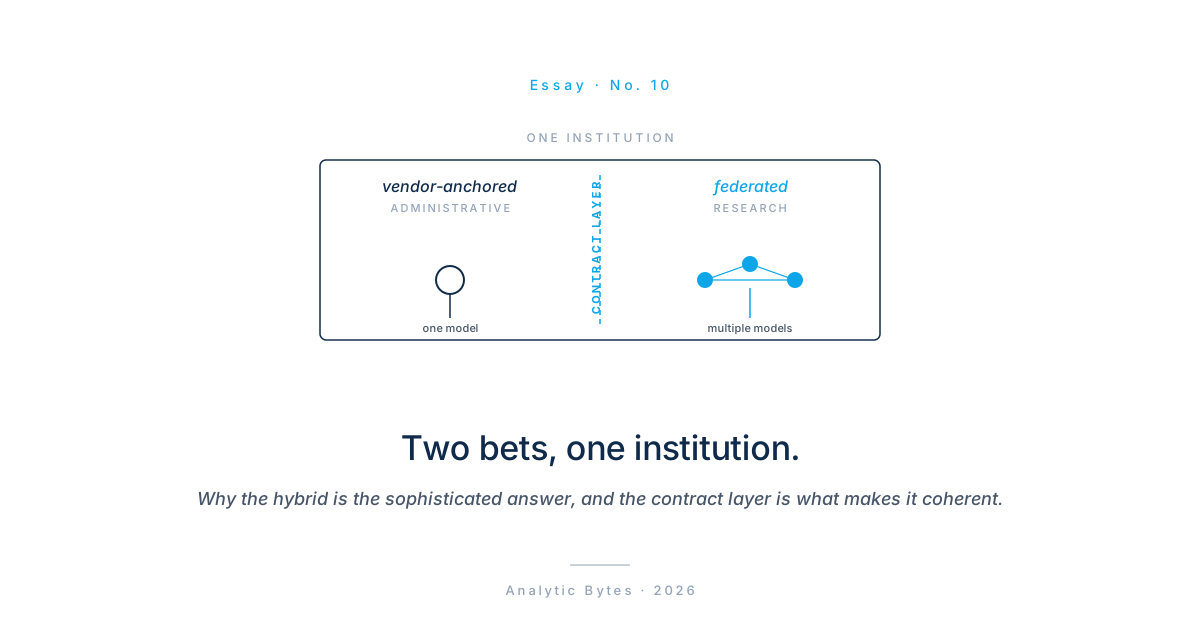
What the vendor-anchored bet buys, and what it trades
The vendor-anchored bet is the one institutions reach for under time pressure. Sign a campus-wide enterprise agreement with a credible vendor (Anthropic, OpenAI, increasingly the platform vendors who have folded foundation models into their existing licensing) and the institution gets a great deal of operational scaffolding immediately. Governance is partly outsourced. The vendor’s enterprise agreement carries the data-handling commitments. Integration is handled at the platform layer rather than by the institution’s engineers. Training, support, and documentation come pre-built. Faculty, staff, and students get a recognizable interface they can use on day one. For an institution under pressure to be visibly responsive to the AI moment, and most institutions are, the vendor-anchored bet looks like an obvious win.
What the bet trades is harder to see at the moment of signing. Vendor switching costs accumulate quickly once integrations are built against the platform’s specific APIs and the institutional workflow has reorganized around the platform’s interface. The institution’s evaluation discipline tends to atrophy because the responsibility for assessing model quality has been delegated to the vendor; over time, fewer people inside the institution can answer the question of whether the model is doing what it claims. The model layer becomes a single point of architectural dependency — and when the vendor moves a feature behind a higher tier, sunsets a model the institution had standardized on, or shifts pricing, the institution discovers it does not have the option to walk away that it thought it had. Public exemplars of this bet are by now familiar. Arizona State University’s partnership with OpenAI, announced in January 2024, was the first institution-level ChatGPT Enterprise rollout in higher education. Dartmouth followed in December 2025, the first Ivy League institution to deploy at institutional scale, with Anthropic’s Claude for Education delivered alongside AWS. The University of Chicago’s partnership with Anthropic, announced in mid-2026, gave students, faculty, and staff Claude Enterprise access on the same architectural shape at the model-vendor layer. Cal State University renewed its system-wide OpenAI deal in May 2026, at $13 million a year for three years, the largest active higher-ed enterprise agreement OpenAI carries, extending coverage across 470,000 students and 63,000 faculty and staff. These institutions made a defensible call. They also, by making it, accepted the trades.
What the federated bet buys, and what it trades
The federated bet looks different from the start. Build an internal abstraction layer (a model gateway, an AI router, a middleware tier) that lets the institution call any model behind a stable internal API. Open-source models hosted on the institution’s own high-performance compute sit alongside calls to commercial foundation models under business-associate agreements. The user-facing interface is the institution’s own; the model behind it can change without changing the interface. What this bet buys is real. Switching costs stay low because the institution is not locked to any single vendor’s call interface. Evaluation discipline stays inside the institution because the orchestration layer requires the institution to make active choices about which model handles which workload. The contract layer, covering who reads what data, who writes what record, on what cadence, under what consent, with what reversibility, is owned end to end rather than partly delegated. The institution can route low-complexity queries to inexpensive models and reserve premium frontier models for use cases that justify the cost. None of that is theoretical. The University of Michigan’s U-M GPT is a real, operating example of owned orchestration at scale — a custom UI tier sitting on top of Azure OpenAI Service and U-M-hosted open-source models, with a three-tier product (U-M GPT for consumption, U-M Maizey for custom-dataset use, U-M GPT Toolkit for full environment control) all governed inside the institutional perimeter. Stanford’s Center for Research on Foundation Models runs and evaluates many models explicitly, the clearest public example of an academic institution treating model evaluation as an owned capability rather than a vendor’s responsibility.
What the federated bet trades is also real, and it is the reason institutions without engineering capital should approach it with caution. Orchestration is now an institutional capability the institution has to build and staff. Integration complexity is higher because the institution is wiring the model layer rather than buying the wiring. Governance is harder. The contracts are no less clear in principle, but they are distributed across more components and require active institutional discipline to keep current. The federated bet rewards institutions that have engineering capital and the appetite to build the orchestration. It punishes institutions that try to federate without the capacity to maintain what they have built.
The same calibration one layer down
The pattern is familiar from an earlier layer of the data stack. At the BI layer, the sophisticated institutions long ago stopped trying to standardize on one tool for every reporting surface — institutional research, executive dashboards, operational reporting, and program-team dashboards have different audiences, different cadences, and different decisions, and they reward different tools. I have argued elsewhere that the BI tool selection is the last decision, not the first, and that the architecture should be set against the surfaces before the tool is chosen. The same calibration logic now extends to the model layer, where the stakes are larger because the contracts between data, model, vendor, and institutional decision are more entangled than the contracts between data, tool, and dashboard ever were.
The same choice plays out one layer down inside the data and AI stack itself, and the two prominent platforms in 2026 make it visible. Snowflake Cortex delegates orchestration to the platform: the institution gets a managed catalog of foundation models (Anthropic’s Claude family, OpenAI’s GPT models, Meta’s Llama, Mistral, Google’s Gemini, Snowflake’s own Arctic, and others as the catalog grows) where the call into the model happens inside Snowflake’s perimeter and the integration with role-based access, audit logging, and the data governance the institution already has in place is part of what the platform delivers. Multiple models are available; orchestration is the platform’s, not the institution’s. Databricks Mosaic AI takes the opposite posture. It is a model-agnostic orchestration layer designed to let the institution bring any model, including open-source models running on the institution’s own compute, and to own the orchestration through the same lakehouse and MLflow tooling the data team is already using. Multiple models are available there too; orchestration sits with the institution. Both platforms are racing to support the full spectrum. Cortex now lets institutions bring fine-tuned open-source models and execute external API stages in some configurations, and Mosaic now offers turn-key managed foundation-model endpoints that look almost vendor-anchored if an enterprise just wants to flip them on. The architectural defaults still betray the posture, though. Cortex defaults to managing orchestration inside its perimeter; Mosaic defaults to handing the institution the tools to build and own the router itself. Any data executive will recognize the parallel. It is the same architectural choice, expressed one layer beneath the rhetoric, and the institutions choosing between Cortex and Mosaic are making the delegated-versus-owned-orchestration decision whether they articulate it that way or not.
Whichever way the orchestration decision goes, it commits the institution to a consumption it has to be able to see. A tier is a decision rule, and like any decision rule it is only as good as the institution’s ability to check whether it is being followed. Routing low-complexity work to a cheaper model commits the institution to two things it rarely arranges in advance: an estimate, before rollout, of what each class of workload will consume, and a way to attribute that consumption back to the department or center that generated it. Without the estimate, a campus turns the system on and learns the shape of its own demand from the invoice. Without the attribution, no dean or program lead can be asked to own the spend their workflows create, and the routing layer decays as teams drift toward whatever model is easiest to call rather than the one the tier assigned. The architectural choice and the consumption it produces are one governance object, decided at design time and owned at run time.
The hybrid is the honest answer
The institutions handling this moment well are not treating the bet as a binary choice. They are calibrating different bets to different domains. The same institution runs vendor-anchored for the use cases where standardization, compliance, and lower risk tolerance reward the vendor’s pre-built scaffolding, and runs federated for the use cases where research-flavored work, multi-stakeholder collaboration, and innovation velocity reward the institution’s own orchestration. The deliberate hybrid is the architecturally honest answer for institutions that have both kinds of work. The accidental hybrid, the one that grew across both domains because no one made an active calibration, doubles the governance surface area without buying safety. An institution without the engineering capital to run a federated bet does not get safer by running a hybrid. It takes on the cost of both domains and the cost of the seam nobody is watching.
The warning above lands differently for institutions inheriting a hybrid from legacy systems they cannot decommission, most healthcare systems, most public-sector ministries, most universities older than the cloud. For them, the hybrid is not a choice. The governance surface is already paid for, whether anyone intended to take the bet that way or not. What matters, in that situation, is running the inheritance as a deliberate calibration of two domains plus the seam rather than pretending the inheritance is a single coherent system. The institution that recognizes an inherited hybrid as a hybrid, and writes the contracts for both domains plus the seam, pays the cost it was already paying, but pays it knowingly. The institution that pretends the inherited hybrid is one coherent system pays the same cost twice over, and the second payment shows up as the surprise when the seam fails.
Four sectors, one pattern
The pattern is most visible in healthcare, where it has been running for years. Academic medical centers run vendor-anchored Epic-and-cloud-AI stacks for clinical and administrative work, because the clinical workflow is standardized, the compliance requirements are uniform, the risk tolerance is low, and the governance benefits of having one vendor’s contracts cover the clinical surface are real. Inside the same institution, the research arms run multi-vendor, multi-model federated stacks for translational research, population health analytics, and model evaluation work, because the research workflow is unstandardized, the disciplines have different needs, open-source models matter for reproducibility, and innovation velocity matters more than standardization. The contract layer between the two domains (what flows from the clinical record into the research analytics, under what consent envelope, with what de-identification, with what reversibility) is the part of the architecture that has taken the longest to mature, and it decides whether the hybrid is coherent or accidental.
Behavioral health runs the same pattern at a different scale. In regional behavioral-health agencies running Certified Community Behavioral Health Clinic services, vendor-anchored EHR-native AI typically handles clinical documentation and billing workflows, because those workflows benefit from the EHR vendor’s pre-built scaffolding. The same agencies run federated approaches for population health analytics, program evaluation, and partner collaboration, because those workflows require the institution to integrate sources that no single vendor owns. The seam between the two domains is where the operational work lives. The freshness contract (what the population-health view shows the clinician at the moment of the appointment, against what cadence the source systems have updated, with what de-identification rule applies) is the load-bearing piece. Agencies that are running this hybrid well are running it without yet calling it one.
Foundations and philanthropy are mid-struggle on the same calibration, and many of them do not yet know that this is the bet they are making. Most foundations have concentrated risk into one grants-management vendor (Fluxx, Salesforce Nonprofit Cloud, Foundant, Bonterra) for grants administration and operations, often without realizing how much of the institution’s reporting capability has been outsourced to that vendor’s roadmap. The same foundations face board pressure to use generative AI for impact reporting, for grant application screening, for due diligence on grantees, and for program-officer drafting workflows, and they have almost zero in-house data engineering capacity to build the orchestration the federated bet requires. The result is a hybrid by drift rather than by design. The grants-management vendor offers AI features that are easy to enable. The research-flavored work (multi-year program evaluation, instrument-version reconciliation across years of survey data, impact synthesis across portfolios) sits in spreadsheets and ad-hoc tools that no orchestration layer reaches. Foundations are roughly where higher education was eighteen months ago on the calibration question: visibly responsive, structurally undecided. The chance to make the calibration deliberate, rather than discovering it after the vendor’s contracts and the federated work have grown apart, is real and narrow.
K-12 networks have been running the hybrid pattern long enough to have generated a precedent the rest of us learned from. The vendor-anchored bet shows up at the student-information-system layer (PowerSchool, Infinite Campus, Skyward), the learning-management-system layer (Canvas, Schoology, Google Classroom), and the assessment-vendor layer. The federated bet shows up in the analytics and student-success work, where networks integrate multiple sources and stand up internal data warehouses to do longitudinal work the vendors will not do for them. The Ed-Fi standard is the federation precedent itself: an open data-interoperability standard that lets districts and states integrate any vendor through a common semantic layer, born to address the integration friction that vendor consolidation at the SIS layer produced. The lesson K-12 supplies to every other sector (not as the blueprint for AI seam contracts, but as the historical pattern) is that vendor consolidation always forces a reactive federation layer later, and federation through open standards is what preserves agility when that consolidation looks rational at the operational layer and turns into a trap at the innovation layer.
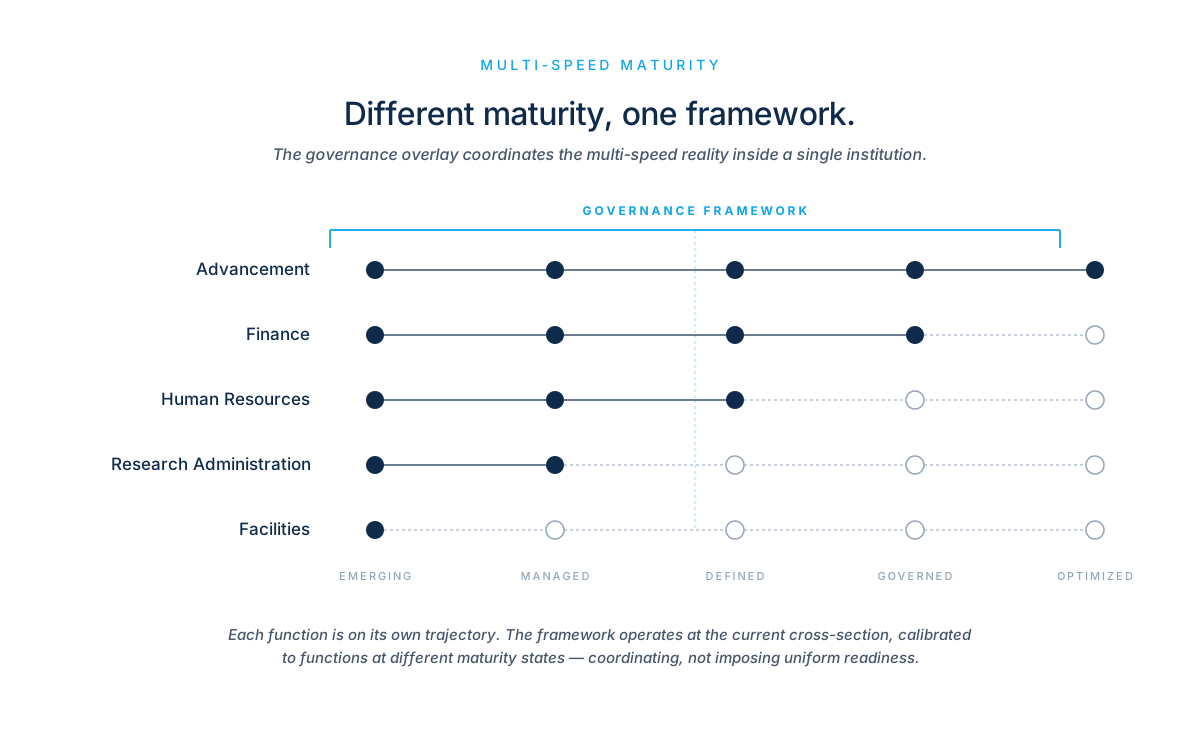
Read the four sector cases together and the principle behind the calibration becomes clear. The more standardized the use case and the lower the risk tolerance, the better the vendor-anchored bet performs. The more research-flavored, multi-stakeholder, and innovation-velocity-dependent the work, the better the federated bet performs. The administrative-research split inside an academic medical center, the clinical-population-health split inside a behavioral-health agency, the grants-administration-program-evaluation split inside a foundation, the SIS-analytics split inside a K-12 network: these are not four different patterns. They are the same pattern, calibrated to each sector’s vocabulary. Higher education stands to inherit the lesson, not invent it. The administrative side of an R1 university (financial systems, HR, the SIS, advancement, the core enterprise reporting) looks more like the clinical surface of an academic medical center than the research surface. The research side of the same university (the disciplines, the labs, the grants, the research computing) looks more like the research arm of the same medical center than the administrative core. The hybrid is the answer the sector is already trending toward. The question is whether higher education calibrates it deliberately or arrives there by drift.
The seam is where the hybrid is earned or paid for
Both bets create governance contracts. The vendor-anchored domain inherits the vendor’s contracts and supplements them with institutional rules. The federated domain owns its contracts end to end. The hybrid creates two sets of contracts plus a third set the institution most often misses: the seam contracts between the two domains. What data flows from the administrative side into the research side, under what de-identification rule, against what consent envelope. What inference the research side returns into the administrative side — and whether the administrative side is allowed to act on it. What freshness the seam guarantees, how the seam is audited, what happens when a record on one side is corrected after a downstream decision on the other side has already been made. These contracts are not theoretical. They are the failure mode of every hybrid that ran for two years and then surfaced a governance breach nobody owned. The seam is where the institution either earns the hybrid or pays for the accident.
What does a seam contract look like in operation, before the institution has it written down? Imagine an R1 running a vendor-anchored portal for undergraduate advising drafts alongside a federated internal stack for institutional-research retention forecasting. The seam contract specifies directionality first. The federated retention score can be read by the vendor portal to prompt the advisor in real time. The advisor’s response, drafted with vendor-anchored AI assistance, cannot be written back to the core student-information system as a record-of-action without a twenty-four-hour human-in-the-loop reversibility window and an explicit second human review before commit. Retention rules come next: the vendor portal is allowed to retain the prompt, not the underlying retention vector that produced it; the federated stack is allowed to learn from the inference outcome, not the advisor’s identity. Cadence sits on top of that: the retention score handed to the portal is refreshed nightly, and any advisor acting on a score older than seventy-two hours is alerted to re-check before continuing. Escalation is the last piece: any disagreement between the vendor-anchored draft and the federated risk signal flags a senior reviewer rather than auto-resolving to either side. Writing this out is not glamorous work. It is what an R1 will wish it had written down before the first vendor portal silently commits a recommendation into a student record that no advisor reviewed and no auditor can trace.
The K-12 sector learned this lesson through Ed-Fi — through the federation that vendor lock-in forced into existence. The healthcare sector learned it through HL7 v2 and FHIR, through the regulation that mandated interoperability after decades of Epic-and-Cerner consolidation. Both sectors learned, at substantial cost, that the contract layer matters more than the technology layer. Higher education and philanthropy have the rare chance to skip a portion of the pain, by recognizing the hybrid as the architecturally honest answer up front and by writing the seam contracts before the architecture has had time to drift.
Neither bet is right for the whole institution, and framing the choice that way misses what matters. What the institution needs to understand, before committing, is the governance contracts each bet commits it to. Vendor-anchored suits the parts of the institution where standardization and lower risk tolerance reward the pre-built scaffolding. Federated suits the parts where innovation velocity and stakeholder diversity require the institution to own the orchestration. Almost every R1, every academic medical center, every foundation that runs both grants administration and program evaluation, and every multi-school education network is already running some version of the hybrid, whether it has been named that way or not. What makes the hybrid coherent is the discipline measurement-science training and operational governance have argued for in every era: writing the contracts down and naming the seams, so the calibration ends up as a deliberate choice rather than an inherited default. Institutions that do that work stop being surprised by their own architecture.
This essay was written in July 2026 for the Analytic Bytes Library. It draws on the author’s practice across higher education, academic medical centers, K-12 networks, behavioral-health agencies, and foundations, and on the public record of higher-ed enterprise AI deployments through mid-2026. The argument is intended to outlast the specific vendors and platforms named.
Questions, pushback, or a problem that looks like this one? Write to chai@analyticbytes.systems.