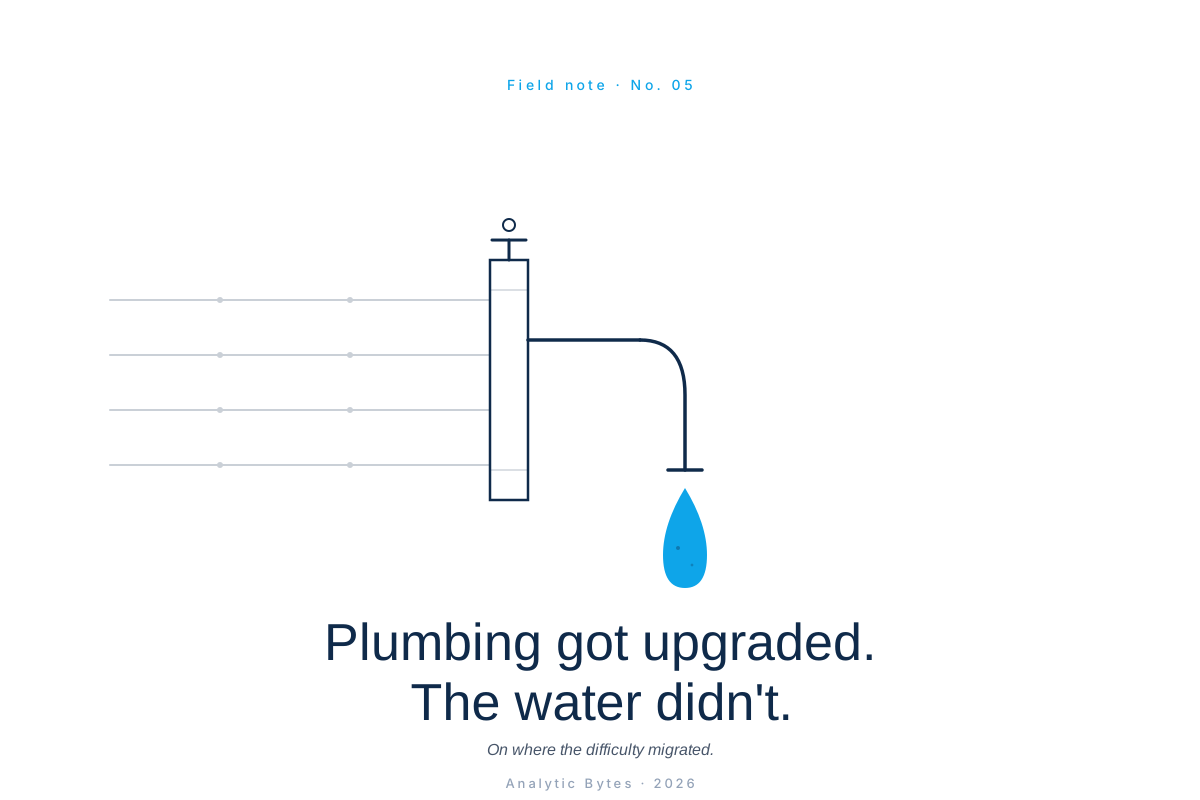
For most of my career, when people asked what I do, I’d say data plumbing. It was a useful shorthand. Everyone got it. The pipes, the joints, the connections between systems, the unglamorous infrastructure that makes everything else possible. Plumbers don’t get a lot of credit. But the building doesn’t work without them.
Lately I’ve stopped using the word.
Not because it was wrong. Because the word stopped meaning what it used to mean.
When I started in this work, plumbing was where the difficulty lived. Moving data between two enterprise systems took months. Integration was a strategic asset. Today the pipes have been industrialized: Fivetran, dbt, Snowflake, the cloud data platforms. The difficulty is no longer engineering the pipe; it’s mostly paying the subscription and managing the configuration. The plumbing got upgraded. It’s a solved problem class, even if individual lines still get clogged.
So if “plumbing” was what I called the hard part of the work, and the hard part has moved, the word doesn’t fit anymore.
The faucet, not the pipes
Imagine your house has plumbing. Pipes run through the walls. Water comes from a treatment plant somewhere. It reaches a faucet. You turn the handle. Something comes out.
The work of getting pipes into the walls — that’s plumbing in the old sense. Most modern houses have it. It’s table stakes.
The work that determines whether you can drink the water, cook with it, give it to a child, wash a wound — that work isn’t in the pipes. It’s: What’s the source. Is the source clean. Did anything get added or removed upstream. What’s the pressure at the faucet: too high and it sprays, too low and you can’t fill a pot. Who’s allowed to open which tap. What happens when the system fails. Who notices.
None of that is plumbing. All of it is the actual experience of having water.
Speed was the only knob we turned
There’s a useful way to think about what AI changed in all this.
For a long time, the only knob most data systems could really turn was speed. Faster pipes. More frequent refreshes. Real-time dashboards. Speed got cheap — that’s most of what the modern stack delivered.
But speed isn’t the only knob. Two others have been sitting there the whole time.
Resolution — how granular a picture you can carry through the pipe. Whether the thing arriving at the decision-maker is the full pattern, or a flattened score that stands in for it.
Context — what surrounds the data point. The cross-system signals and the constraints that change what a number actually means.
AI made all three knobs more accessible. The speed knob was already turned up; that’s the part most institutions invested in. The resolution and context knobs are still mostly at their default positions. That’s the gap. Not that we lack speed. It’s that we haven’t spent the other two. (There is a fourth dimension worth naming separately: whether the construct in the pipe is still the construct you sampled last quarter. That one gets its own treatment in “The construct keeps moving.”)
The Thursday afternoon
Consider a Thursday afternoon in a college advisor’s office. A junior student-athlete has skipped three classes and tripped the LMS risk flag. The bursar’s stack shows their aid disbursement is on hold for a missing verification document. The campus dining system hasn’t seen a swipe in forty-eight hours. All three systems know something. None of them are talking to the advisor across the desk. The plumbing ran perfectly. The student still slipped through the seam.
When I look at what I spend my time on now, it’s almost entirely those kinds of moments, applied to data. Not can we connect these two systems — yes, almost always, fine. The questions that stay hard are: what does the field actually measure, whose number wins when two systems disagree, who’s allowed to read what, who’s allowed to change it, on what cadence, and when it goes wrong, who notices.
That’s not plumbing. That’s closer to running a water authority.
It’s worth naming the distinction directly. Most institutions have some form of data governance in place: the policies that decide who can access which table, how a field is defined in the catalog, how lineage is tracked. That work is real and necessary. But data governance is governance of the pipe. Decision governance is governance of the faucet — who’s allowed to act on what comes out, at what resolution, on what cadence, and what kind of decision the architecture is built to support. An institution can have mature data governance and almost no decision governance, and the seam still fails.
The same Thursday afternoon happens in a clinic. In a behavioral health agency. In a K-12 district trying to act on an early-warning flag. In a foundation reviewing grantees. In a workforce board trying to know whether a participant is on track. The shape doesn’t change. The systems hold pieces. Nobody has the picture.
The water authority
The analogy keeps holding up.
The water treatment plant, the place that decides what counts as drinkable water and tests every batch, is the construct question. Are we measuring what we say we’re measuring. Is the thing in the pipe still what it was when we sampled it last quarter.
The municipal authority, who decides which neighborhoods get pressure, who sets the testing cadence, who’s responsible when the boil-water advisory goes out, is the governance contract. Who reads. Who writes. Cadence. Authority. This is the contract at the seam: the point where the architecture stops and a person has to act on what comes through. Most institutions have a contract for the pipes: vendor SLAs, integration agreements, data-sharing terms. Few have one for what happens at the faucet.
The faucet itself, the moment someone turns the handle, is the decision. A dosage adjustment, a budget call, an eligibility flag, a credit limit, a clinical alert. That’s where the entire stack either works or doesn’t. And the agentic era is already installing faucets that turn themselves on, mix their own temperature, and pour before a human can taste what’s coming out of the tap.
The engineers who used to be your bottleneck, the integration specialists — they’re more like the contractors who installed the pipes in the first place. Important, but not who you call when the water tastes wrong.
The contract at the seam
If I had to describe the contract at the seam in plain terms, it has four pieces.
Who is allowed to act on the signal.
What data they see, and at what resolution.
On what cadence the signal reaches them.
What kind of decision the system is built to support.
That last piece is the one most institutions skip: what kind of decision. They build for monitoring, then ask the same plumbing to support intervention, and the seam fails. The work is matching the architecture to the decision the institution needs to make.
The water is the work
I think the reason I’m slow to give up the old word is that “plumbing” has a kind of working-class honesty to it. It signals: I do the unglamorous part. I don’t oversell.That register matters in a field full of overselling.
But the truth is, the unglamorous part isn’t the pipes anymore. The unglamorous part is the water — what’s in it, who decided what gets in, who’s responsible if it makes someone sick. The pipes are fine. The pipes were never the problem most institutions thought they were.
If I had to describe what I do now without picking a clever new name for it, I’d just say it’s water authority work. Sourcing. Testing. Pressure. Authority. Who’s allowed to drink. The integration layer is solved enough to not need most senior people’s time. The layer that determines whether what comes out of the faucet is fit for purpose — that layer is barely staffed at most institutions, barely contracted for, barely measured. It’s the gap between we have a data warehouse and we can make a decision.
Plumbing got upgraded. The water didn’t.
That’s the work.
This field note was written in June 2026 for the Analytic Bytes Library. The longer arguments referenced here live in other library pieces: What Is This System Actually Measuring? (the water-safety question), The numbers don’t agree because the words don’t (when two pipes feed the same tap), The Contracts Between Systems and related work on who writes the contract (authority at the seam).
Questions, pushback, or a problem that looks like this one? Write to chai@analyticbytes.systems.