The frame
Cross-functional work feels less like collaboration and more like a football play. Eleven specialists, one designed play, executed in a single coordinated burst against a defense built to break it.
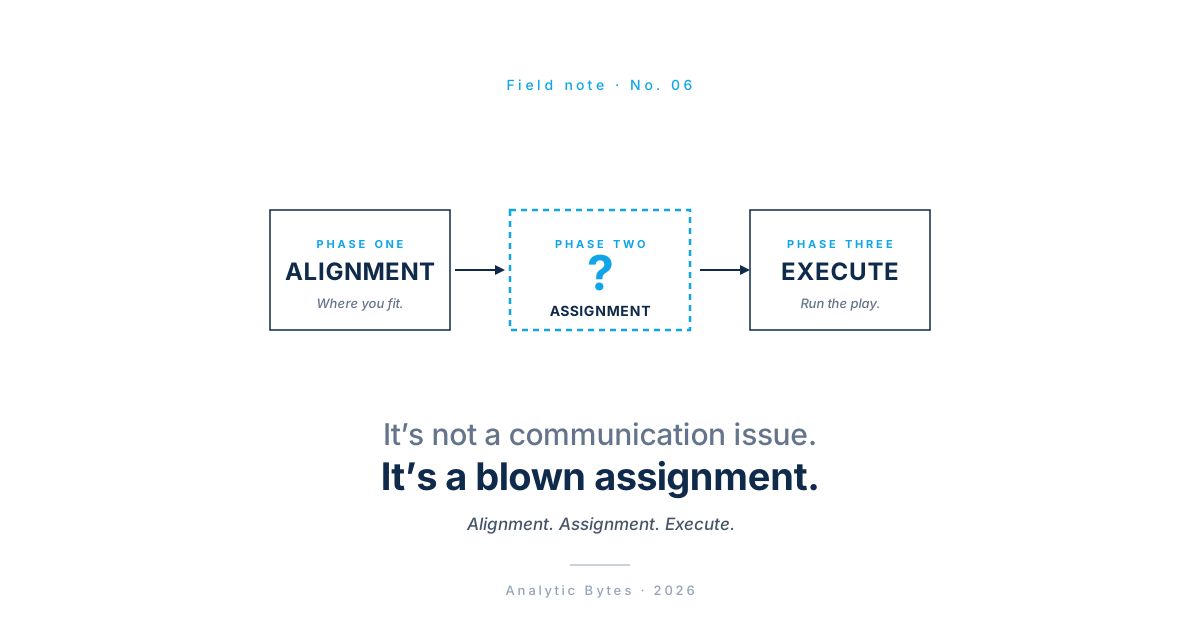
Football coaches drill the same three-word mantra every year: Alignment. Assignment. Execute.
Know where you stand. Know what you do. Run the play.
That’s the whole frame. It does most of what cross-functional teams actually need.
Three phases, three failure modes
Alignment is where you fit relative to everyone else. In football, it’s where you stand on the field. In cross-functional work, it’s where your function sits relative to the others. Who you partner with upstream. Who you hand off to downstream. Whose problem becomes your problem when something doesn’t move.
Alignment failures look like this. The school counselor, the behavioral health clinic, and the family are all aware of the same student. None of them know who is supposed to be carrying the picture. The student is not missed because no one cared. They are missed because everyone thought they were on someone else’s coverage.
Assignment is what you do on this specific play. In football, it’s the difference between blocking the inside gap and pulling left to lead block. Same player, two completely different jobs depending on the call.
Assignment failures look like this. The data architecture is fine. Three systems flow into a dashboard. The advisor sees the dashboard. Then nothing happens, because nobody wrote what should happen. There is no contract that says if the score crosses this line, who acts, with what authority, on what cadence. The dashboard isn’t the problem. The missing assignment is.
Execution is the actual play running. The line moves on the snap. The receiver runs the route. The quarterback reads and throws. The timing has to be inside a fraction of a second.
Execution failures look like this. The alignment is right. The assignment is right. The operational handoff still fumbles. The discharge plan was written. The follow-up was assigned to the care coordinator. The care coordinator was out for a week, and nothing escalated. The play was called. The play didn’t run.
Three phases. Three different failure modes. One play.
Why “a communication issue” is the wrong diagnosis
Most institutions diagnose all three as the same problem. We have a communication issue. And schedule another meeting.
A communication issue treats all breakdowns as if they were the same flat thing, but they aren’t. An alignment failure needs a clearer organizational map. An assignment failure needs a written contract. An execution failure needs operational redundancy — a backup when the named person is out. Three different fixes. Three different conversations. Three different artifacts.
The meeting can name the breakdown. It can’t fix any of them.
Where the AB lane sits
Most of the work we get pulled into looks like a data problem on the surface. A dashboard nobody uses. A handoff that doesn’t stick. A metric that lives in someone’s email instead of moving into a workflow. None of those are data problems. They are alignment problems, assignment problems, or execution problems misread as data problems.
The fix is the play. Written down. Owned by named roles. With the contingencies designed in. That’s the seam contract. That’s the artifact the modern data stack does not ship in the box.
The plumbing got upgraded. The play didn’t.
That’s the work.
Written June 2026 for the Analytic Bytes Library. Composite of cross-functional patterns observed across K-12, behavioral health, and higher-ed engagements; specific examples are abstracted. The longer arguments referenced here live in companion pieces: Plumbing got upgraded. The water didn’t. (why integration isn’t the decision), The Contracts Between Systems and Who Writes the Contract (what lives in a seam contract), Two Bets, One Institution (how to decide whether to build the play in-house or partner for it), and What Is This System Actually Measuring? (whether the construct is still the right one).
Questions, pushback, or a problem that looks like this one? Write to chai@analyticbytes.systems.