The mismatch
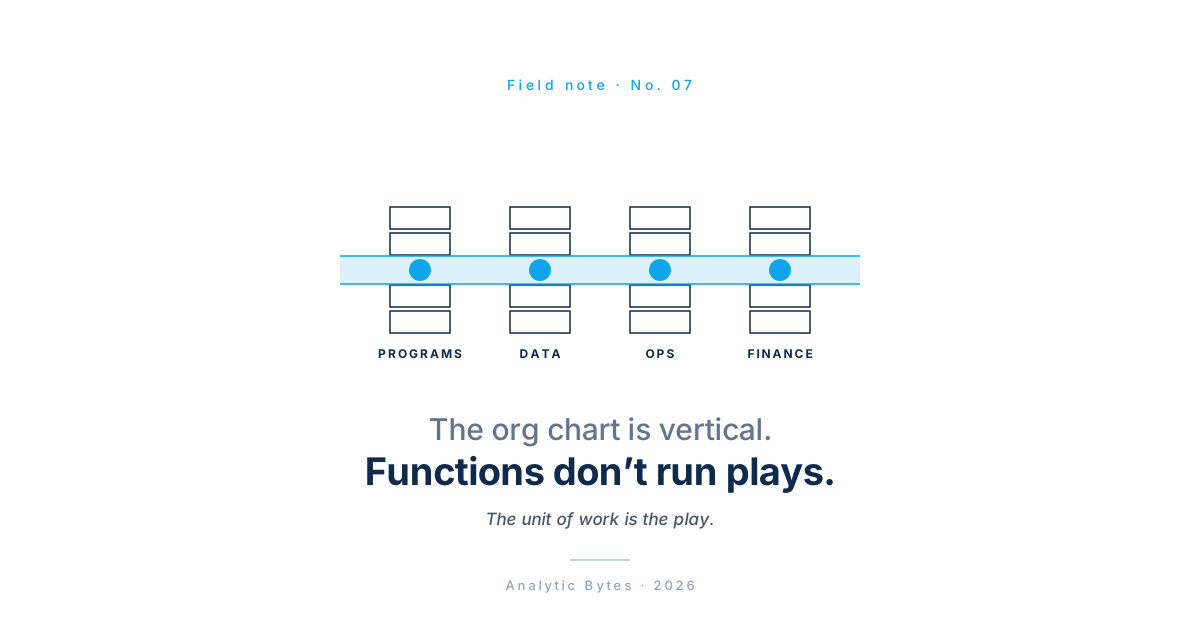
The work is horizontal: a specific deliverable, a specific clock, expertise drawn from several functions. The org chart is vertical: each function reporting up to its own executive, evaluated against its own scorecard, accountable to its own incentives. The mismatch is structural. It does not go away when the people are smart and well-meaning. It is the structure.
So institutions patch it. The patches are familiar. A standing cross-functional meeting names the breakdown without fixing it. A matrix reporting line multiplies the bosses without changing the unit of work. A communication issue diagnosis schedules another meeting. The heroic senior hire is expected to span every layer the org chart failed to connect, then gets sighed about as a unicorn when one person cannot.
More than one honest answer
There is more than one honest structural answer to the mismatch, and the field of practice is diverse. Councils. Steering committees. Advisory boards. Working groups. Task forces. Tiger teams. Flash teams. Agile squads. Product teams. Centers of excellence. Each carries a different profile on permanence, authority, composition, and purpose. Each has a legitimate role in the institutional toolkit.
Three archetypes cover most of the actual practice.
Deliberate together, execute locally
A cross-functional body (a council, a steering committee, a working group) deliberates and writes a shared playbook. The playbook names the definitions, the handoffs, the timing, the cadences, and the decisions the cross-functional work depends on. Each function then takes the playbook back to its own team and runs its portion inside its existing operating context. Advancement, facilities, research management, and academic affairs contribute to the same playbook in council, then execute their piece each in their own house. Widespread in universities, foundations, and mission-driven organizations. Can run for decades.
Merge for the deliverable
Flash teams (Melissa Valentine and her collaborators at Stanford named this pattern), tiger teams, project teams, task forces. Expertise is drawn from across functions and merged into a single team for the duration of the work. When the work is done, the team dissolves. Expertise returns to the function. More common in tech, product, and consulting.
Standing cross-functional composition
Agile squads, product teams, centers of excellence, matrix teams. Ongoing teams drawn permanently or semi-permanently from across functions. Common in software organizations and in mature product-led institutions.
These are structurally different. They carry different rhythms, different authority patterns, different membership assumptions. Which one fits depends on the institution and the work — the operating rhythm, the permanence of the effort, the authority pattern already in place, the culture that has to receive it. What is common to all three is what the football piece called a seam contract: who acts, on what signal, at what cadence, with what authority. The container is the institution’s choice. The contract is not optional.
Not anti-function
None of this is anti-function. Functions are where deep expertise lives and grows. An evaluator reports into research and evaluation. An advisor reports into student success. A clinician reports into clinical operations. The function is the home of the role, and that does not change.
What changes is what runs the play.
Whichever container carries the work (a merged team, a council with a playbook, a standing squad) draws expertise from the functions for a specific deliverable and carries its own seam contract. It is authorized to form across functions by an integration seat that has the standing to make the arrangement stick. When the work lands, the container’s rhythm adjusts. A flash team dissolves. A council closes a chapter. A squad rolls onto its next mission. The expertise stays home. The next play composes a different container.
The football piece in the library named the artifact underneath all of this: the seam contract. The plumbing piece described the same artifact at a different layer, between architecture and human. Contracts Between Systems and Two Bets, One Institution describe it at still other layers. Seams all the way down, each with its own contract. This piece is about the one that runs across the org chart when people, not systems, are the ones handing off.
The agentic era intensifies this
The agentic era does not change this argument. It intensifies it.
Agents can be introduced at every layer where a seam contract exists. The container that absorbs them (flash team, council playbook, standing squad) matters less than the contract they are joining. What matters is that the contract exists at that layer, with its four pieces named: who acts, on what signal, at what cadence, with what authority. Without a contract, an agent at any layer creates the same problem: decisions made without an owner, without a cadence, and without the standing to reverse.
The consequence of introducing an agent scales with the layer. An agent inside a data pipeline is a technical operation; a failed transform is a rerun. An agent inside a clinical alert, an eligibility flag, or an intervention call is an institutional action; a failed call is a person harmed. Most institutions will introduce agents first at the layer whose failures are reversible, then work upward as the contracts at higher layers mature. That is not a claim about where agents belong but rather where they safely arrive first.
The patches will not hold. The work is horizontal. The org chart is vertical. The mismatch only grows.
The unit of work is the play. The mechanism that runs it across the org chart is a seam contract. Some institutions carry that contract in a flash team. Some in a council playbook. Some in a standing squad. All are honest answers. None works without the contract.
Written June 2026 for the Analytic Bytes Library. The flash-team construct comes from Melissa Valentine and collaborators at Stanford; the council, squad, and product-team archetypes reflect standard practice across higher education, foundations, healthcare, and tech. The longer arguments referenced here live in companion pieces: Plumbing got upgraded. The water didn’t. (why integration stopped being the hard part), It’s not a communication issue. It’s a blown assignment. (the play as the unit of cross-functional work), Where Should Data Sit? (the seat that authorizes the play to form), The Contracts Between Systems (the seam contract at the system-to-system layer), and Two Bets, One Institution (seam contracts between institutional domains).
Questions, pushback, or a problem that looks like this one? Write to chai@analyticbytes.systems.