A take-home is a compressed, unusually honest instrument. The clock is short, so the organization cannot dress the problem up. It has to hand you the thing it wants help with. And what an organization reaches for when it wants help tells you, with some precision, how it understands its own data. Do enough of them and the individual scenarios blur, but the shape underneath stops being noise. The same handful of things are wrong, and wrong in the same order.
Say this plainly first: none of these organizations was bad at data. That is the part worth sitting with. Most had real systems, real analysts, real dashboards. They were good at data and still stuck. That is the whole point, and the rest of this piece is why.
The brief that names everything but the decision
Here is a take-home, lightly abstracted. A principal writes: the seniors just took their college-entrance exam, I am presenting at professional development this afternoon, I need this back in an hour. Then a list. Averages by subject, the share above a threshold score, which homeroom did best, how one student group performed against two others, whether GPA tracks the score, how the teachers compare. And the last line: anything else you find interesting.
It is a completely reasonable request. Read closely, it is also a request for outputs, not a decision. Six questions, a slide deck, an hour, and nothing about what gets done differently once the slides go up. “Anything else you find interesting” is the tell. If a decision were driving the request, “interesting” would already be defined — interesting toward what. Its absence means the analysis has become the destination.
Nearly every take-home had this shape. Build the dashboard. Write the trends report. Produce the plan. A surprising share did not ask for analysis-toward-a-decision at all. They asked for compliance: get the new state attendance codes computing correctly, get the course-collection feed accurate and auditable. That is necessary work. But compliance is the purest form of the pattern, an output the organization must produce with no decision attached to it at all. When most of what a data function is handed is outputs and filings, it becomes a service desk. And a service desk, however fast, however good, never gets to the decision.
The two-line change that touches seven systems
One task asked, in effect: your state just introduced two new attendance codes. What would you change?
The honest answer was uncomfortably long. To make two codes compute correctly you would touch a database view, a stored procedure, the student information system’s configuration, the outbound fields in the state report, the data-validation checks, the way front-office staff enter attendance each morning, and the historical records already on file. Two codes. Seven systems.
That task is not hard because attendance is conceptually difficult. It is hard because the concept “attendance” is defined in seven places, with no single place to change it. This is the fault line under half the take-homes: the organization has no canonical definition of its own core measures, so every measure exists in several slightly different versions, and any change, or any disagreement about a number, becomes an archaeology project. An organization in that state is not one tool away from fixed. It is one decision away — the decision that each measure means one thing, computed in one place.
A dashboard is not a decision surface
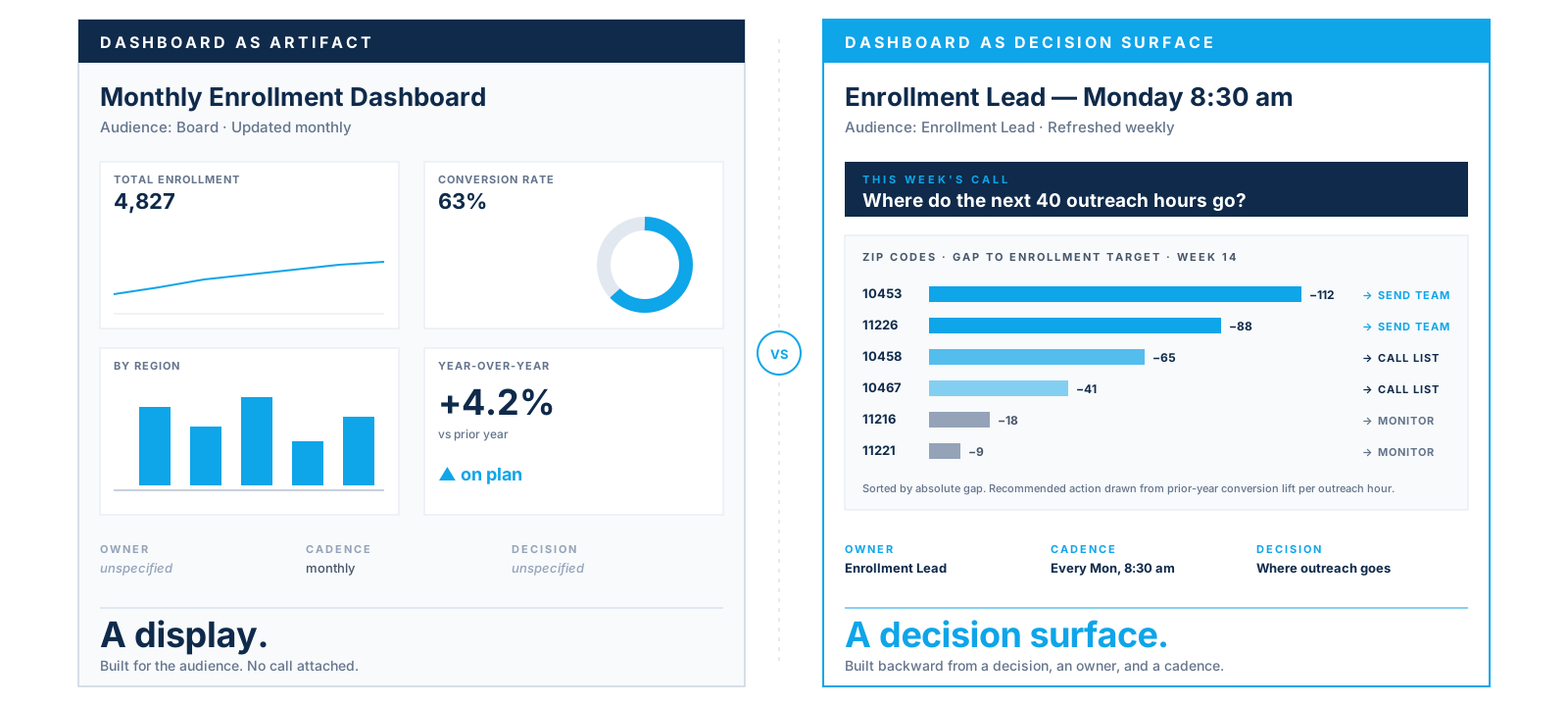
Almost every take-home asked for a dashboard or a report, and asked for it the same way: as an artifact. Build a monthly enrollment dashboard for the board. Produce a topline executive trends report. Submit a dashboard you have made. The deliverable is the thing — built, presented, monthly.
Not once was a dashboard requested as the surface a named person uses to make a specific recurring call. The enrollment dashboard was never framed as “what the enrollment lead opens every Monday to decide where this week’s outreach goes.” It was framed as a board-reporting object.
The difference is not cosmetic. An organization that asks for “a dashboard” and an organization that asks for “the Monday-morning surface the enrollment lead decides from” will get two different objects. The first is a display. The second is a decision surface, built backward from a decision, an owner, and a cadence. Both have charts on them. Only the second changes what happens on Monday. Most briefs ask for the first and hope for the second.
The organization hires a person to be the system it never built
Several take-homes asked for leadership-grade systems thinking: a first-ninety-days plan, a risk-and-change-management plan for replacing core systems across several regions at once, a strategy for collecting and safeguarding sensitive personal data. Anticipate resistance. Build buy-in. See around corners.
These are the right things to ask of a senior hire. But the implication is quiet and worth catching. The organization knows it has a systems gap, and its plan for closing it is to hire a person who will carry the system in their head: hold the definitions, broker the cross-functional agreements, remember the edge cases, watch the corners.
A person is not a system. A person takes vacation, gets pulled into a crisis, and eventually leaves. When they go, the systems thinking walks out with them. The take-home that asks for a brilliant ninety-day plan is, underneath, an organization hoping a hire will substitute for an architecture. The best version of that hire spends the ninety days building the architecture instead, so the organization stops depending on any one person’s memory, including their own.
One dataset, four audiences, no infrastructure
The last pattern was the most repetitive, and the most expensive. Present this to leadership and to teachers. Adapt this report for school leaders, for staff, for families. Prepare talking points for two executives walking into two different meetings.
Every organization needs the same underlying numbers spoken in three or four registers: board, operator, frontline, external partner. None had a system that did the translation. So every cycle someone re-renders the same data by hand into each new voice, and that manual work competes for the same scarce hours as the analysis itself. The result is a data function permanently busy and permanently behind, not because the analysis is hard, but because the distribution of it was never built as a system.
What the set adds up to
Read together, more than a dozen take-homes point at one thing, and it is not a skills gap. These organizations had analysts, tools, and dashboards. What they did not have was the layer between the analysis and the decision: a canonical definition of each measure, a surface built backward from a specific recurring call, a distribution system that speaks to every audience without redoing the work, and an architecture that outlives the person who built it.
That layer has a name. It is the decision system. And the take-home is an honest instrument because it catches an organization in the act of reaching for more analysis, under real pressure and in good faith, when the thing missing is the system that connects analysis to a decision.
The reframe
A decade of take-homes taught me one habit, and it is the one I would hand to anyone who commissions this kind of work. When an organization gives you a data problem, the first job is not to answer it. It is to find the decision underneath, the one the brief did not name, and answer that. The slides the principal asked for take an hour. The question of which students get which support this term, who owns that call, and from what surface they make it — that is the work, and the brief never mentioned it.
Do that a dozen times and something shifts in how you see. You stop seeing data problems. You start seeing decision systems with one part missing, and often you can name the missing part inside the first honest conversation. That is the whole of it. Most organizations do not have a data problem. They have a decision-system problem, and a take-home is a short, honest way to surface one. From fragmented to decision-ready is the distance between the brief they wrote and the brief they meant.
Written May 2026 for the Analytic Bytes Library. Drawn from interview performance tasks completed between 2017 and 2026; organizations and task specifics are abstracted throughout, and no individual organization’s task, scenario detail, or data is reproduced.
Questions, pushback, or a problem that looks like this one? Write to chai@analyticbytes.systems.