In healthcare, you don’t pick one data source and use it for everything. You stitch CDC mortality data with NSDUH prevalence, claims data with electronic health records, patient-reported outcomes with hospital encounter feeds. Each layer measures something different. Each runs at a different cadence. Each serves a different decision. The work is in the integration: what kind of question goes to which layer, and how the layers compose into a coherent picture of a population, a patient, a program.
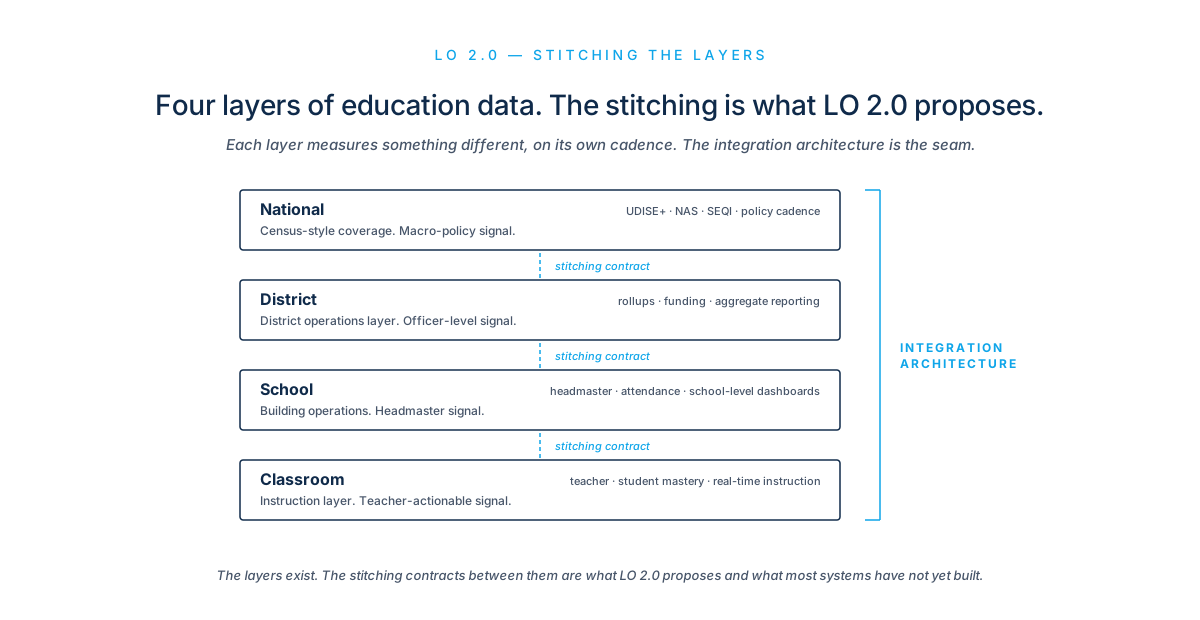
Education has the same opportunity. India, specifically, has an unusually rich set of national data systems: UDISE+ for school-level infrastructure and enrollment, NAS for sample-based achievement, PGI for composite ranking, SEQI for composite quality. Below that, schools have classroom assessments, board exam results, NCERT-aligned learning materials, and increasingly digital assessment platforms in some districts. The layers exist. The integration architecture isn’t yet built.
The pattern is familiar from US K-12 too. A district runs its SIS for attendance and enrollment, NWEA MAP for growth on standardized assessment, an internal mastery tracker on Illuminate or a classroom-embedded platform, disciplinary data on Kickboard, and a state accountability assessment once a year. Each layer measures something different, on its own cadence, purchased with its own budget line. The question they were all meant to help answer — which classrooms need which support this term — is the one the layers rarely compose into on their own.
That integration architecture is what LO 2.0 proposes: the thing that stitches national, district, school, and classroom layers into coherent decision support for teachers, headmasters, district officers, ministries, and policy designers.
This is the analytical landscape, the state-level evidence that integration matters, and the framework for building it.
The layers and what each is good for
UDISE+ (Unified District Information System Education Plus). Census-style coverage of every school. Strong on infrastructure adequacy, demographic patterns, enrollment trends, attendance aggregates. Weak on learning outcomes, individual student tracking, and real-time signal. Best used for: macro-policy decisions, infrastructure investment, demographic-shift analysis, federal funding allocation.
NAS (National Achievement Survey). Sample-based, high-quality achievement assessment, fielded only every few years. Reports state and group averages. Strong on national snapshots and inter-state comparison. Weak on improvement tracking, classroom-level signal, and cross-cycle comparability when grades sampled change. Best used for: periodic state benchmarking, policy effectiveness review, resource-prioritization signals.
PGI 2.0 (Performance Grading Index). Built for state-level comparison, federal incentive frameworks, and publicly visible accountability. A composite index that combines UDISE+ and NAS into ranking grades across 73 indicators on a 1,000-point scale. Don’t reach for it when the question is operational or improvement-shaped; it won’t carry the weight.
SEQI (School Education Quality Index). Composite ranking, evaluative framing. Last report 2019. Useful as historical baseline; less useful as current signal.
Local classroom assessments. Whatever each school or district has built: weekly tests, board-exam practice, digital adaptive platforms in some districts. Strong on classroom-level cadence and granularity. Weak on standardization, comparability across schools, and aggregation upward.
Board exam results. Annual, summative, high-stakes. Strong on student-level outcomes at terminal points (Class X, Class XII). Weak for formative use during the year.
The pattern is recognizable: each layer does something well, and each layer has a clear failure mode. None alone is sufficient. Stitched through an integration architecture, they can serve a teacher, a headmaster, a district officer, and a policy designer reading the same assets at different cadences.
The picture for one state
Andhra Pradesh, 2021. NAS data shows Class X performance below 50% on every measured learning outcome, and below the national average on 16 of them. Eighty percent of students at or below basic level in Math; 94% at or below basic in Science; 86% at or below basic in Social Science. Performance is far worse in every upper grade than at Class III: at-or-below-basic in Math sits near 80% from Class V (82%) through Class X (80%), versus 63% in Class III. That is a jump after the foundational grade, not a steady climb. The clean grade-on-grade decline shows up in Science instead: 65% at Class III rising to 94% at Class X. The state-private gap is wide — 85% at or below basic in Math at state schools against 73% at private, a 12-point spread. AP graded Akanshi-1 overall on PGI 2022–23 (third-lowest band), and Akanshi-2 on the learning-outcomes domain. Thirty-nine percent of teachers reported overload of work.
These signals come from national data. They’re real. They’re useful for federal allocation, for state-level priority-setting, for policy design.
What they don’t yet tell anyone is which classrooms in which districts need which kind of support this term. That answer requires the local layer (student-level continuous assessment, teacher-feedback loops, principal observation) running in tandem with the national signal.
A district officer reading the NAS data alone gets AP is underperforming in Math. A district officer reading NAS + classroom assessments + teacher-feedback together gets these 12 schools have the steepest grade-level decline in Math fluency, these 4 of them have the highest teacher-PD need, these 2 have the strongest prior intervention response. Same data, different decisions enabled.
This is what stitching makes possible. None of the layers alone enables it.
The LO 2.0 framework
Three pillars, each addressing a specific integration gap.
Classroom assessments at the cadence the classroom runs at. A digital assessment platform integrated into instructional flow. Built-in items anchored to curriculum progression (CBSE or state). Drill-down insights by standard and topic for early remediation. Real-time dashboards for teachers. Differentiated learning support pathways at topic and sub-topic level for at-risk students. Reduced teacher workload on creating assessments and lesson plans. The assessment cadence matches the classroom cadence; the data gets back to the teacher within the week.
A central Operational Data Store that joins the layers. Integrating data from existing portals (UDISE+, NAS, PGI inputs, board exams, state-level systems) and the new classroom assessment layer. Automated reporting. Standardized score cards comparable across schools and districts. Growth KPIs alongside achievement KPIs as the primary lens for closing learning gaps for students with varying ability (CWSN) and varying access (income, gender, SC/ST groups). The integration layer that makes the national signal usable at the district level and the local signal aggregatable at the policy level.
Decision surfaces for different decision-makers, reading from the same data. Teachers reading classroom-level continuous assessment for differentiated instruction. Headmasters reading school-level patterns for staffing and PD allocation. District officers reading aggregated school patterns for resource and PD allocation. State ministries reading aggregated district patterns for policy and funding. Federal designers reading the same data for allocation and policy. Each decision-maker reads what they need at the appropriate granularity. The semantic layer underneath is shared.
The decisions stitching enables
The integration is not abstract. With the layers stitched, specific decisions get sharper.
Teacher actions at the classroom level. Which students need re-teaching on which standard this week. What differentiated practice fits which subgroup. Which intervention worked the last time a similar pattern showed up.
Student outcomes tracked longitudinally. Year-over-year persistence in mastery. Cohort growth trajectories. Early identification of students whose pattern suggests intervention is needed before the next high-stakes assessment.
Teacher professional development designed around real evidence. Which schools have the highest teacher-PD demand based on classroom-level outcome patterns? Which districts are running interventions that work and could be replicated?
Funding and resource allocation grounded in granular need. Federal allocation has historically run on UDISE+ infrastructure data and PGI rankings. Stitched data lets allocation also reflect classroom-level outcome trajectories, closer to where the need is.
Policy that can read both signals. A state ministry reading aggregated district patterns alongside aggregated classroom signal can design policy that targets the gap, not just measures it.
This is the same parallel as healthcare. CDC + NSDUH + claims + EHR + patient-reported outcomes don’t replace each other; they enable different decisions for different actors at different cadences, provided the layers between them are stitched.
The pilot proposal
Ten to twelve weeks, Class X, Math and Science, a selected low/medium-performing district, state curriculum (with CBSE optionally included for Class VIII or IX). Pre- and post-assessment to measure efficacy. Weekly assessments to track growth. Real-time dashboards informing instruction. Pre-built differentiated lesson plans. Student-behavior data on planning, engagement, guessing, and test-taking skills. Teacher training on data-driven practice. Student and teacher reflection surveys.
Deliverables: a comprehensive statistical analysis of student learning outcomes; a prototype centralized operational data store with dashboards across teacher, headmaster, district, and state surfaces; teacher training and survey materials; recommendations for scaling.
Closing note
Education-policy debates often frame “national data systems vs. classroom assessments” as a binary. They aren’t. Each layer does something the other can’t. The question isn’t which to invest in; it’s what integration architecture lets them serve different decision-makers running different decisions at different cadences.
Healthcare has spent decades building toward this, integrating CDC + NSDUH + claims + EHR + patient-reported outcomes through population-health platforms and clinical decision-support systems, though it is far from finished even there. Education hasn’t yet built the equivalent. LO 2.0 is one shape that integration architecture could take.
The integration argument is illustrative. State-level findings reflect NAS 2021 and PGI 2022–23; a refresh against the NAS 2024 cycle would update the picture without changing the architecture. Pilot timing and scope are sketched for orientation; an actual engagement would scale to the district’s existing assessment infrastructure and academic calendar.
The opportunity is sitting in the layers already collected. The work is to stitch them into decision surfaces for the people who have to act.
That is decision-systems architecture at state-government scale: start from the assets already in place rather than the ones that are missing, route each decision to the layer that can answer it, and give every decision-maker (teacher, headmaster, district officer, ministry) a surface built for the call in front of them. The portal was never the point. The work is to go from fragmented to decision-ready, whether the fragments are clinics, schools, or a national education system.
Written May 2026 for the Analytic Bytes Library. State-level findings reflect NAS 2021 and PGI 2022–23 cycles. The Andhra Pradesh Class 10 figures cited above trace to the NCERT PARAKH NAS 2021 dashboard (Andhra Pradesh › Class 10 › By Range of Performance). Subsequent NAS 2024 and PGI releases would refine the picture. The integration-architecture argument is intended to outlast specific cycle data.
Questions, pushback, or a problem that looks like this one? Write to chai@analyticbytes.systems.